Search This Blog (A.K.A. "I Dote On...")

Showing posts with label Blairmont. Show all posts

Friday, January 29, 2010

North of Delmar / East of Troost: Dividing Lines and Redevelopment

For Kansas City, Missouri, St. Louis's cross-state urban neighbor, Troost Avenue "has been dividing rich and poor, black and white, jobless and employed since the days of Jim Crow when it was a legal line of segregation."

Sound familiar, St. Louis? Delmar Boulevard has become St. Louis's version of Troost. It's a line of demarcation nearly every St. Louisan knows, no matter which side of the line you're on.

When Paul McKee, Jr. began buying dozens upon dozens of parcels in several distressed "north of Delmar" neighborhoods in the early 2000s, many commentators would applaud his major risk in tackling large scale development on the North Side. Both McKee and supporters of his vision for his massive redevelopment area claimed that his initially secretive land assemblage was the only way to acquire the land needed to revive a chronically depressed area. Some even stated the obvious; who else was going to touch such a large collection of neighborhoods north of Delmar?

Well, as the above-linked article demonstrates, knocking down these barrier roads doesn't have to be a secretive process that alienates local residents. Kansas City's new "Green Impact Zone" initiative seems an innovative approach to a redevelopment of a distressed and stigmatized group of urban neighborhoods. Let's read more about it below.


Today the neighborhoods east of Troost Avenue still bear the marks of disenfranchisement: abandoned homes, an unemployment rate that’s as high as 53 percent in some census tracts and gun violence that takes many young lives.

But tomorrow, this area could be a center of green jobs, retrofitted energy-efficient homes, a green transportation system and hopeful residents if Congressman Emmanuel Cleaver’s plans for using American Recovery and Reinvestment Act (ARRA) funding come to full fruition.

U.S. Rep. Cleaver, D-Missouri, has developed an ambitious plan for a “Green Impact Zone” to be established in a 150-block area east of Troost Avenue. He convinced the Kansas City Council to vote 13 to 0 to allocate millions of dollars of ARRA money and considerable city effort to this part of the city. And he’s rallied dozens of community organizations, residents and even businesses to work on making it happen. Now Cleaver’s office and the team from the community are submitting applications to numerous Recovery Act programs, supplementing work that’s already begun to bring a greener, healthier environment to this area and jobs to its residents.

At the heart of the plan for the Green Impact Zone is a massive home weatherization project that would put area residents to work conducting energy audits and weatherizing the 2,500 homes in the Zone neighborhoods.


What do I see as a part of this proposal?

Number one: leadership with a vision. This scheme wasn't hatched by some private developer with a hidden agenda and no real commitment to the area in question. It was a local representative trying to better quality of life for his constituents and using his role in government to bring about positive change. Where does this happen in St. Louis? It has not happened for St. Louis Place and Jeff Vanderlou, at the very least. Further, Rep. Cleaver is arguing for a use of ARRA funding that goes beyond finding ways to better move vehicles on larger roads. He had a vision for the area and went about planning it and building a coalition--with neighborhood residents. No secretive "land assemblage" needed.

Number two: creating employment for local residents. It is clear to us now that Paul McKee, Jr. approached the NorthSide development idea with a slash and burn mentality. Many occupied apartments were emptied to lessen resistance and gain more control of the land. Residents who couldn't be bought out were subjected to little if any property maintenance on the acquired parcels, leading to brick vandalism and arson. Who wants to live next to that? Moreover, what resident who lived through this is going to find McKee  trustworthy in a redevelopment of the area? McKee's conduct with the NorthSide development is indicative of the fact that he merely wants to pull off a successful and profitable redevelopment--not better the lives of the people who currently live there. As he is a private developer, I can't say I'm surprised. While residents of the NorthSide project area are left to defend their own turf with little protection from the city of St. Louis (see the Community Benefits Alliance), residents of Kansas City can breathe a little easier. The Green Impact Zone would put residents to work weatherizing and rehabilitating area homes. This will contribute to quality of life for current residents and serve to refurbish the physical infrastructure of neighborhoods involved all at once. Which leads me to my next point...

Number three: preservation is a part of the plan! What a novel concept! You have a neighborhood full of solid, historic homes that have fallen into disrepair. Rather than landbank and demolish through messy eminent domain proceedings, you instead put people to work renovating the existing housing stock. A sense of place and history is preserved and everyone seems to benefit.

Number four, there's coordination with regional and neighborhood organizations. Kansas City's Metropolitan Planning Organization, the Mid-America Regional Council is administering the application process for the Green Impact Zones, while existing neighborhood organizations have already been consulted for their input and involvement in the initiative. Perhaps most importantly, there is public planning baked into the process. With St. Louis's NorthSide development, the prospects are much more glum. There are no true planning or urban design guidelines offered by the city of St. Louis--which may soon cut two full-time positions from its already weak, advisory Planning and Urban Design office. How can we ever expect sound urban development without a unified voice from the city as to the appropriate scale and design of new development in our neighborhoods? This vacuum of leadership has already lead to gas stations subsuming formerly dense mixed-use corridors, driveways and other suburban accoutrements in urban residential settings, etc. How can citizens be assured that the NorthSide development be above the current standard of development in the city of St. Louis: bare mediocrity? 

Maybe I'm giving this fledgling Kansas City plan too much credit. But do yourself a favor and read the whole article. Try your best not to be a little jealous. How does Kansas City "get it" and St. Louis does not? What might hold our activists back in realizing community benefits such as preservation and employment? We too can attempt to tear the Delmar barrier down, but I'd rather see it done the Troost way.

Tuesday, September 22, 2009

With NorthSide Project, the Villain is the Process

Wow.

What a circus the NorthSide development has been as of late.

Talks of McKee's holdings in NorthPark facing foreclosure. A near meltdown by McKee himself over blogger Doug Duckworth's videotaping of a public meeting. Reports on Claire Nowak-Boyd's blog that McKee has indeed been empyting out North Side buildings and buying out landlords (only to later reneg and force them into foreclosure while also threatening the future of the buildings themselves). Oh yeah, and that whole bit about the city having to back its largest TIF request ever.

Whew.

Of all the things that could be said, I would like to highlight one.

McKee, a private developer making this huge TIF request and subjecting the Near North Side to further degradation, can certainly be accused of wrong-doing. The jury has sort of already delivered that verdict.

The real enemy here, at least looking at the breaches against historic preservation and urbanist principles, is twofold:

A) we don't have a coherent plan to guide urban development throughout the city


and


B) we don't have meaningful ways for citizens to influence the decision-making process.


Therefore, I would argue, it's the process, and not Paul McKee, Jr., who's really to blame here.


That is a half-hearted indictment of the leadership of the North Side and the city as a whole coming from me. But a lot of the problems, of course, are due to an anemic, visionless, and bureaucratic leadership rather than one outright malevolent.


So this process? Well, you might hate that the San Luis is getting torn down for a surface parking lot; you might detest that Crown Plaza just north of downtown is your run-of-the-mill strip suburban center; you may loathe Loughborough Commons for its lack of a pedestrian realm; and indeed, you may despise McKee for trashing several sensitive, historic neighborhoods.


Yet our zoning allows all of the above. Our Preservation Board, and moreover the process of preservation in the city, is beyond circuitous. The process can only be described as so ridden with holes that it would puzzle a preservation expert much less a mildly interested plainclothes citizen. At any rate, a citizen's right to contest Preservation Board decisions has been taken off the table by Judge Dierker in the case Friends of the San Luis v. St. Louis Archdiocese. (Well, if you're a next door neighbor or have direct economic interest, then you're fine to contest...).


And what about planning? Does our city do it? We have a Planning and Urban Design Agency, but they're largely advisory. So the Strategic Land Use Plan of 2004 developed by then lead planner Rollin Stanley goes largely ignored because there was never any legislation to enforce it. So, the Building Division continues to issue demolition permit after demolition permit in neighborhoods deemed "Neighborhood Preservation Areas" by that same Land Use plan. Much of the North Side isn't under "Preservation Review" and isn't in a local or National Register historic district either, so the demolitions simply go unreviewed. If the vacant lot ever attracts the attention of someone willing to build something--unless they're going to receive tax abatement status for the property--they're not subjected to any sort of urban design standards. So we get more suburban-style commercial and residential buildings where they really just don't seem to fit.


Try to contest any aspect of any of this. What department do you start with? Who do you complain to? Will you even hear a response? Won't your alderman have the ultimate say in almost all matters anyway? It seems so.


So, if you want to be an activist for your own neighborhood, you better develop a friendly relationship with your local alderman. Better yet, run for the position. Because if that alderman already has enough friends that don't think like you do with regard to urban design and preservation, then you'd better rest assured none of the other alderman are going to throw a wrench in his plans (thank you, aldermanic courtesy!). It's as good as a done deal. So when the redevelopment agreement goes before the Board of Alderman, as it must in order to pass and become a reality, we have no assurance that any aldermen outside of the 5th and 19th Wards, primarily, will truly have a say.

Citizens of the North Side should not have had to fight to hold the TIF hearing at a time more amenable to public participation. And what's this about the removal of a NorthSide project naysaying commissioner from the TIF commission? That doesn't sound like a democratic process to me.

If St. Louisans' ability to access their government and the decision-making process were simpler, more straigtforward, and less politicized, our built environment's present state might not be so piecemeal. We have to remember that the biggest problem with the NorthSide project is that, when or if this TIF is approved, the city has no planners to assist McKee on appropriate urban design, and indeed, no means to demand it from him. There's no progressive zoning ordinance to rely on. The project area's not under Preservation Review and is not "officially" historic (it's neither in a local nor National Register district), so ultimately residents will have no say over which buildings stay or go.

So, if we're looking at the possibility of a suburban developer attempting to wave a magic wand over the North Side, and we have no means of either stopping what he takes from the built environment or influencing what he puts in, is it his fault? Or is it a horrible broken process that denies citizens due influence over the outcomes of major decisions affecting the built environment?

While Paul McKee's conduct thus far with the North Side has been highly questionable, this seems like an appropriate time for citizens to demand more power and control of the shaping of their city.

Saturday, July 18, 2009

Northside Project Community Benefits Alliance Includes Provision to Modify Preservation Review

The citizens of the wards affected by Paul McKee, Jr.'s Northside Regeneration project have drafted an innovative document that, if adopted, would certainly alter how the project proceeds and what it does for current residents. Read the Community Benefits Alliance's work here on their website.

Of particular interest to me is the call for residents--not the Building Division--to review proposals for demolitions in all of north St. Louis (not just the project area, even).

Neighborhood Control of Preservation and Demolition: We propose an immediate moratorium on demolition north of Delmar, and meaningful neighborhood control of preservation and demolition. In order to preserve the valuable housing stock and architectural heritage north of Delmar, we believe that all of north city should be put under a revised form of Preservation Review, where proposed demolitions would need to be approved by the Neighborhood Development Advisory Board prior to review by the St. Louis Preservation Review Board. In addition, we expect any emergency demolitions be approved by the Neighborhood Advisory Board prior to approval by the Building Division, to prevent a developer from using this known loophole in preservation planning to demolish salvageable historic buildings which meet community standards for rehabilitation. This will preserve the community’s ability to access the State Historic Tax Credit program as an engine for economic development.

Emergency demolition permits are the easiest way to bypass preservation legislation in the city. Simply let your building precipitously decay (removing boards from windows helps) and watch as the city grants you an emergency demolition permit.


But a lot of the North Side is not in either a local historic district or a National Register District. North Side wards are also basically missing from Preservation Review, a process that ensures each demolition permit is reviewed by the Cultural Resources Office instead of simply going straight through to the Building Division, who almost always approves permits.


This bold suggestion of having the community review what of their building stock is important to them is innovative. It may not be airtight itself (some people, especially without architectural backgrounds, tend to unilaterally favor new construction at the expense of old). But the language in the CBA is still a bold step in the right direction of instituting citywide Preservation Review.


It's unbelievable to me that a city in 2009 would allow for a huge North Side warehouse to be dismantled (for a parking lot? This is getting beyond old.) Yet this demolition sailed through without so much as a notice at a grocery store.


This is simply unacceptable. The NorthSide CBA is one of the only public voices I have heard that has proposed this "radical" solution to our city falling further into an unwalkable, uninteresting, semi-rural haven for the automobile.

Thursday, June 4, 2009

Paul McKee, Urban Assets Both on List of May Demolition Permits

Of 10 completed emergency demolition permits in May, 9 were North Side addresses and 1 was a Central Corridor address.

More interestingly, a company controlled by Paul McKee, Jr. of "NorthSide" fame saw the demolition of at least one more property. The firm Urban Assets that has been covered by Michael Allen as another potential Distressed Areas Land Assemblage Tax Credit Act recipient demolished two in May.

Here's the list:

5031 Claxton - Mark Twain Neighborhood
Emergency Demolition of a One-Story Single-Family House
Owner: Bryce Peters Financial Corporation

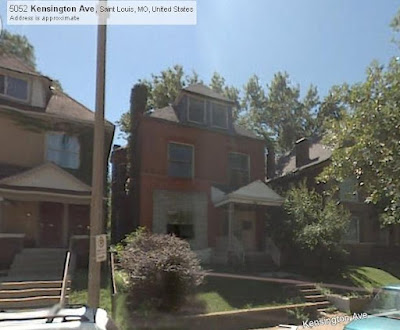
5052 Kensington - Academy Neighborhood
From Montly Demo Permits

Owner: Urban Assets

Urban Assets owned this lovely St. Louis foursquare that the city says was built in 1896. Located within the Mount Cabanne-Raymond Place National Register District, this demolition should have gone before the Preservation Board, which has jurisdiction over demolition permits in National Register districts. Emergency demo permits bypass this review. This is yet another demonstration that emergency demolition permits should be reviewed by the Preservation Board. Not processing these emergency permits undermines the process of preservation. This block of Kensington has suffered an unusually high level of demolition for its relatively intact host neighborhood. Urban Assets is hopefully not starting the same process of real estate speculation and expedited decline that has earned McKee so much distrust.

4643 San Francisco - Penrose Neighborhood
Owner: Frances May

2507 Slattery - JeffVanderLou Neighborhood
Owner: Babcock Resources, LLC, linked to Paul McKee, Jr.

If you recall one of my earlier posts, McKee's companies have now demolished several buildings on this same block. This site sits several blocks west of one of McKee's proposed job centers (at Jefferson and Cass). Still, could they be clearing anything adjacent to the proposed job center site early on? It's possible.

4335 Evans - Vandeventer Neighborhood
From Montly Demo Permits

In the Bing Maps capture provided above, 4335 Evans is the house just to the left (west) of the multi-family property.

Owner: DHP Investments

Con artist Doug Hartmann incorporated DHP with the stated intention of renovating hundreds of properties across the city. These renovations never materialized for most properties. One high profile DHP holding was the now mostly destroyed Nord St. Louis Turnverein in Hyde Park. For more reading, click here. The future of their current holdings remains up in the air. This one received an emergency demolition permit.

1456 Hamilton - Hamilton Heights Neighborhood

Photograph provided by the City of St. Louis.

Owner: LRA


5900 Kennerly - Wells Goodfellow Neighborhood
Owner: John A. Davis


5858 Lotus - Wells Goodfellow Neighborhood

Photograph provided by the City of St. Louis

Owner: Urban Assets

Yet another Urban Assets property. Hmm...

528-34 North Newstead - Central West End Neighborhood

Photograph provided by the City of St. Louis

It tooks like this spare but attractive CWE multi-family building has been felled for a potential new townhouse development, as seen in the picture below (also from the City):


4216 N. 20th Street in Hyde Park is also on my list, but Michael Allen has already lamented this senseless loss.

I will be tracking demolition permits monthly to see if there is an uptick or a pattern in McKee- or Urban Assets-related demolitions.

Tuesday, May 26, 2009

Blairmont. McEagle Project. NorthSide.

With so many bloggers shedding further light and offering constructive comments on the recent Blairmont plan (the Post-Dispatch has caught on, too), I hope you forgive me for a somewhat narrative-style post more laden with commentary than solutions/suggestions.

As I mentioned in my previous post, I was in St. Louis last week and was able to attend Thursday's public announcement--McKee's first public appearance and official announcement of his plans for dozens of acres of the Near North Side.

It seems that the planners have gotten everything right for this project. I fully endorse sustainable design, new and improved transit options, urban formatted retail, and new jobs for the city.

The one thing they completely botched? Scale.

By now, St. Louisans should be wary of the promises of a silver bullet scheme. There have been so many in the city's history and its recent past.

Lumiere Casino was going to salvage Laclede's Landing. I see more traffic and people within an area generally thought of as the Landing, but it's doubtful that the project has improved the viability of the compressed little district. Somehow, it's still not possible to rebuild the fallen Switzer Building. And the only thing possible for the former Port St. Louis residential development? An "observation wheel" that's bound to turn the Landing into even more of a dysfunctional and unfriendly urban funhouse. In addition, Lumiere requested and was granted the demolition of the McPheeters warehouse complex (for what?) along with a swath of North First Street for a surface parking lot. The city has simply handed the keys to the city over to Lumiere and there is little evidence that it's actually benefiting the area it was meant to benefit. (Granted I'm sure it's revenue added to the city's coffers, but what happens when the glitz and glamor wear off and Lumiere becomes a tired-looking megastructure with an odd lighted crest?).

A new ballpark for the Cardinals complete with an adjacent village was supposed to build on a revitalization in the southern portion of downtown. "Ballpark Village" will be a softball field and surface parking lot for years, in all likelihood, before development begins. When built, Ballpark Village will likely be a smattering of boring Class A office space that will suck space from other parts of downtown. I hope I'm wrong, but this is the stated goal of our mayor with the Ballpark Village development. With a narrow vision, the city sees a wedge of land north of the stadium as a silver bullet project, not realizing that working in tandem with the Cupples redevelopment, the Chouteau's Landing project, and rebuilding the life-sucking parking garages around the stadium would already constitute a "village".

So suddenly Paul McKee, Jr. awoke to discover that north St. Louis matters to the whole city and region--much like Laclede's Landing and downtown. Yet the myopic vision is still the same, no matter how well the urbanistic concepts (mixed use, walkability, etc.) seem to be incorporated. The notion of one developer with total control simply doesn't work for vibrant urban areas. Sure, "NorthSide" is set to have development partners, but I tend to think this is more out of necessity than a realization of the organic nature of urban growth and development. Plus, MODOT, one of the partners, has shown itself to almost completely disregard the residents of St. Louis City. Where was the series of public meetings that should have occurred regarding the alignment of the new Mississippi River Bridge? I'm sure there were some, but should there not have been a massive, massive campaign to inform all affected parties? I may not have been in St. Louis, but I didn't see too much coming from the Post-Dispatch either.

The scale of NorthSide is too large and the development team already suspect. The promise that McKee will "save every building he can save" and designate them "Legacy Properties" is already rendered moot by the fact that Near North Side architectural gems--vernacular, mid-19th century architecture not to be found anywhere else in the country and certainly never to be replaced--have been felled by the dozens. Plus, as Robert Powers has articulated on his blog, McKee could have shown himself a North Side hero if he had simply renovated all of his owned properties within the reviving Old North St. Louis neighborhood. Instead, he has slowed down that neighborhood's remarkable progress and now nonchalantly insists he'll gain control over the property that is the resilient neighborhood's future renovation showpiece--the Mullanphy Emigrant House. This development team--and its partners--have little sense of the history and importance of north St. Louis no matter whose father operated the Cass Avenue streetcar. If they did, they'd understand that buildings like the Brecht Butcher Supply Company Buildings that they owned--on Cass--were crucial to the existence of that very streetcar.

Yet we can already see the pattern renewing itself: the city is handing the keys over to McEagle. Political backing? Check. Massive TIF? Check. A PR campaign that markets the project as the "only way to save" north St. Louis? Check.

The scary part of this development is how little trust the citizens can have in their own government. The involved North Side Aldermen have gone from outrage to co-optation. The Mayor and his Chief of Staff have known of the development for a long, long time. Michael Allen and Rob Powers' work in exposing the deplorable conditions of Blairmont properties has made a liar out of McKee. How? If he thinks the only way to assemble vast tracts of land (a questionable task in and of itself) is to remain secretive so as not to stir up the speculators, then his scheme's cover was blown long ago. That would have given said speculators enough time to imitate his actions. But no one did. Government has been behind this from day one. And there is no Planning Agency with teeth to speak of that, when the government pushes this development through despite any and all opposition, will then review the plans and make sure they fit in an urban and historic context. There is also no Preservation Review because Clarence Harmon had the forethought to make Preservation Review an opt-out, ward-by-ward system. So there is basically no governmental mechanism to either resist the development outright or demand that it be better.

That leads me to my assertion that, despite all of this, I am optimistic. There is a group of "wired" St. Louisans--bloggers, UrbanSTL forumers, and other young professionals--that genuinely want to improve the quality of life of their city. They're educated already or are educating themselves on what makes a vibrant city and what quashes vibrancy. They're learning to scrutinize "economic development" and to critique plans that promise jobs/development but are inappropriate in scale, design, or implementation. Beyond that, there is also a good group of dedicated residents of the project area who are willing to fight for sound development. I had the pleasure of meeting Sheila Rendon of the Neighbors for Social Justice in St. Louis Place, and I believe her voice, and other residents, will be critical in crafting a better plan.

Despite Lumiere, there's still a huge interstate barrier that reduces the Landing to a single-use nightlife district with extreme parking pressures. Despite clearance of the old Busch stadium, there's still an undeveloped parcel with dreary parking garages surrounding it. Silver Bullet projects need more than one developer's vision. They need a public to refine their visions and see them to proper implementation.

A public voice founded on civic optimism and community betterment is growing stronger, louder. The NorthSide project could provide the tipping point where a broad coalition of St. Louis residents unites, finally, to ensure that these silver bullet schemes are refined and do what they're supposed to do: enhance the quality of life in the City of St. Louis.

Thursday, May 21, 2009

Blairmont Meeting

Tonight I attended the Paul McKee meeting at the Central Baptist Church on Washington in Midtown (yes, I've been in town for the past couple days). From the sound of the meeting, it was similar to, if not the same as, the event held last week that was exclusive to invited stakeholders. Therefore, offering a summary would just be a repetition of earlier posts from other blogs--Ecology of Absence, Urban Review, Vanishing STL, St. Louis Urban Workshop, and others.

I don't know if the last meeting had a particularly potty-mouthed heckler that had to be dragged from the meeting, but this one did.

I'll hold my full thoughts until this thing develops further. For now, I think that this is a more than moving description of, shall I say, a couple caveats about the Blairmont "redevelopment" project: read Curious Feet's beautiful post here.

Friday, April 24, 2009

A Digest

It's been a busy semester and a sparse blog as of late.

I have a lot to catch up on, and thought I would do so in rapidfire fashion:

First, the Mayor's inauguration speech. Impressive. No, really. He actually engendered a bit of civic confidence and pride. A couple standouts, though, were his calls to hire more young professionals to staff Planning and Urban Design (as well as IT and the Citizens Service Bureau), his confidence in the revitalization of North City (via Paul McKee, Jr.?), his threats against MODOT to start considering public transit, and, of course, the call to reenter St. Louis City into the County.

My suggestions? Give Planning real power in city government and then seek the professionals. Who wants to work in an "advisory" agency that has real little power? Well, okay, I would love the job, but would be extremely frustrated at the limitations of the office. Rollin Stanley surely was. The city will continue to lose these talented and energetic people if the process of government is designed to exclude them.

Re: North City, it's rumored that the Blairmont Master Plan will be introduced to the Board of Aldermen shortly...

Re: MODOT, bravo, Mayor Slay! Just think: if St. Louis City joins the County, Metro will have an easier time passing transit funding bills.

Which brings me to the next point: yes, St. Louis City entering the County is the conservative solution to undoing the Great Divorce of 1876. But it's a necessary first step, really, to the healing of a fractured regional psyche. If the City and County showed a dedication to work together to solve urban problems within both, the region could shift the dynamic away from the growing western fringes and back toward the center.

Next Up: the Walgreens coming to Lafayette just west of Tucker. Urban STL forumers who attended a recent public meeting have said that Walgreens will actually build up to the street and will add a faux-second story to better fit in with the surroundings. The new store will even attempt to match the detailing of the Georgian across the street. While I'm sure this will turn out laughable, think of the alternative: the beige or white box with way too much parking surrounding it on three sides. No thanks. I am happy to hear this news!

Next: Various local business news.

It appears that Five Bistro is moving to 5100 Daggett on the Hill (formerly Pizzeria del Piazza), leaving its Grove location empty. Yet I hear from a friend that the former El Mundo Latino restaurant at the northwest corner of Manchester and Tower Grove may be getting rehabbed as we speak. Putting that corner back in use would be a major shot in the arm to the still-struggling western end of the Grove District along Manchester.

As reported by Sauce Magazine, this nifty building in Benton Park will be host to a wine bar called Ernesto's. Check out the Streetview from 2007 and then look at the massive rehaul the building underwent.


Photo Source: St. Louis Investment Realty

Now, did I call the Patch neighborhood's coolness or what? The Post-Dispatch is reporting that a partnership between Steins Broadway, Inc. and Rothschild Development may transform the former Coca Cola Syrup Factory into 77 new lofts and the home of Lemp Beer! Awesome news.


Lastly, the Kiel Opera House is coming back to life, finally (well, I suppose we should wait and see, but it appears a done deal). This is nearly 100 percent positive news--except the parking situation. The talks are that the adjacent Abrams Building will be hollowed out and turned into a parking structure. It's time the city showed leadership on this issue. Not every development should receive its own garage. Surely the city's new Tucker/Clark garage could service most able-bodied patrons; the rest could benefit from set-asides from the Scottrade Center attached garage.


That's it for now.

Thursday, April 16, 2009

Keep Your Eyes on Blairmont

Even though the rumor is that Blairmont is planning a mixed-use community that will incorporate preservation, their track record remains terribly suspect.

Demolition permits seemed to have spiked in the Blairmont neighborhoods (St. Louis Place and Jeff Vanderlou, primarily). Here are a few recent permits issued by the Building Division. All that are listed have been completed, which means these buildings are no more. Images are provided by the St. Louis Community Information Network site ("Geo St. Louis").

2513 Slattery
Neighborhood: Jeff Vanderlou
Owner: Sheridan Place
Demolished: January 20, 2009

Notes: The city describes the demolition permit as "Rubble Only--Emergency". Was this a brick rustled property?


2617 Slattery

Neighborhood: Jeff Vanderlou
Owner: VHS Partners
Demolished: January 20, 2009
This one is on the same block as the previous; they were both destroyed on the same day, leaving a massive gap in the middle of a long block. Hmm...

Notes: Another rubble removal.


2303 Hebert
Neighborhood: St. Louis Place
Owner: Blairmont Associates
Demolished: February 4, 2009


2318 Hebert
Neighborhood: St. Louis Place
Owner: Blairmont Associates
Demolished: February 11, 2009
Notes: This was an emergency demolition permit.

2547-49 Dodier Neighborhood: St. Louis Place
Owner: Dodier Investors
Demolished: March 13, 2009
Notes: This one is really upsetting because it's a corner building. Once these go, the integrity of the already weak block is bound to suffer.

Other non-Blairmont demolitions in the area:

2517 Glasgow (Jeff Vanderlou)

3110 N. 23rd (St. Louis Place) - This one is another tragic demolition. It's a gorgeous Second Empire alley house (it fronts the alley between Sullivan and Hebert). Wait, I should say it fronted. The city says it's gone as of February 24, 2009. Unique properties like this need careful stewardship, not careless disregard.


2249 Sullivan (St. Louis Place)
Another lost attractive corner building.


4135 Page (Vandeventer neighborhood).
Okay, so this isn't Blairmontville, but it's still unfortunate. The left (west) twin the set was demolished earlier this year.


The number of demolitions in the City of St. Louis per year without any sort of redevelopment plans seems staggering. Though I've only included North City demolitions here, with a focus on Blairmont, there are many surprises over the past couple months. These include demolitions in rows of housing that have never seen any alterations in their history (Bevo and Southwest Garden) and a corner unit in a very historic neighborhood (Tower Grove East).

St. Louis desperately needs citywide preservation review. Every time I return to St. Louis, it's emptier in multiple senses of the word. Blairmont has caused a quick degradation of a longtime suffering bunch of neighborhoods; they appear to have ramped up their destructive efforts as of late.

Why can't we citizens have a say?

Monday, February 9, 2009

Mayor Slay Comments on Blairmont! New mixed-use community?

On developer Paul McKee’s Blairmont project, which is buying up hundreds of properties in north St. Louis with plans to build a new mixed-use community: Slay said he supports the effort, but that McKee would have to go through the same city approval process as anyone else. He welcomed McKee’s private investment and big plans. “What Paul McKee is doing is he’s putting his own money in, completely at risk. … He’s buying up properties that, in the vast majority of cases, no one else wanted. This is a real opportunity for an area that has been starving for private investment for a long, long time.”


Source.

Notes:

A new mixed-use community? Does the Post-Dispatch know something the public doesn't? Sure there's been speculation of a "Winghaven East," but with the downturn in the economy, I thought everyone was now expecting a huge industrial park a la Northpark.


And Mayor Slay: how hypocritical! You talk of your progress in getting problem property owners prosecuted (see Toby Weiss's commentary on those dubious claims), yet you're supportive of a (still secretive) development that has skirted almost all nuisance ordinances on the books! Yikes. Residents of St. Louis deserve some dialog in these "big" projects.


At least we know exactly where Mayor Slay stands now. Should help me (and others) in the voting process come March 3, 2009.


Kudos to the Post-Dispatch for making Slay speak on Blairmont!


EDIT: Might I add that the Distressed Areas Land Assemblage Tax Credit renders the statement that McKee's finances are "completely at risk" a little ridiculous.

Thursday, February 5, 2009

Before and After in St. Louis Place

2002 City Aerial - St. Louis Place

2008 City Aerial - St. Louis Place


If you scroll through these images quickly, you can see the effects of Paul McKee and Blairmont. A couple dozen buildings disappear in this six year span.

(Put them in the same position on a PowerPoint file to get the best visual effect. Scroll back and forth and watch the neighborhood disintegrate, looking worse despite the obvious difference in seasons.)

Tuesday, October 28, 2008

One of the last remaining historic buildings on Cass Avenue is gone


Demolished on May 5, 2008 for $15,000.

The city was decent enough to take a picture of the new vacant lot on September 9, 2008:


Annually, the number of demolitions in neighborhoods like Jeff Vanderlou is simply staggering. So are the costs to demolish.

Each year, Jeff Vanderlou becomes more like parkland owned by the LRA (and, of course, Blairmont) than the dense urban neighborhood it once was.

Monday, September 22, 2008

I haven't forgotten about Blairmont!

Neither has Rob Powers, who's on Day 188 of the Daily Dose of Blairmont.

It's simply ludicrous that any private citizen can track so many instances of illegal demolitions--with photographic evidence--and not produce any reaction from the local leadership.

Whether you want a big economic development scheme for North St. Louis, or you're squarely opposed to anyone touching the land other than a community-based entity, you should be against what is occurring right now. A well-connected, monied developer continues to chip away at neighborhoods, inciting further crime, abandonment, and disinvestment--saying nothing of preservation of irreplaceable architecture. We've seen rampant arsons and brick rustling. We've seen a lot of activity by Paul McKee and his various holding companies, but little activity from city government.

This is no way to "redevelop" neighborhoods.

This is one big, city-rubberstamped crime. It's also an excellent precedent for top-down, secretive planning when all other civilized places go to great lengths to avoid that kind of "planning".

This could happen again--somewhere else. Could the Ville be next?

What can I do? Locked down in New Orleans, what can I do?

Tuesday, August 12, 2008

Our Bricks

Walking home the other day, through one of New Orleans' most beautiful Creole neighborhoods called the Marigny (that's MARE-in-ee), I spied a refurbished sidewalk out front of an up-to-the-street cottage.

The brick pavers looked worn, full of character--like they'd had a gloriously long lifespan already to be so graciously reincarnated.

As I looked closer, I saw the word:

ST. LOUIS

I suddenly hunkered closer to the sidewalk in fearful hope of finding another. I must have looked like I was rearing to pounce on a lizard or something to an outside observer.

I found another.

ST. LOUIS.

Scrawled across the ruddy brick in arcane, large letters.

And another.

ST. LOUIS.

Then one with a company's name (wish I could remember it). Underneath that company's name?

ST. LOUIS, MO.

Could it be? Blairmont's brick rustlers are making their dimes off of New Orleans' streetscaping needs?

This article seems to hint that our bricks are headed to New Orleans to aid in the recovery.

I can't bear to think, though, that the Near North Side might be being sacked for sidewalks down South.

And that I might be walking over my home town's heritage on a daily basis.

Could it be true?

I walked down two more blocks.

Another sidewalk re-do.

I scan once more, bending my torso far too forward on account of my poor eyesight. These bricks look just like the other. No intermittent St. Louises though. Hmm...

Aha...tucked away. A signature brick, emblazoned with those letters I could never let escape from my view.

ST. LOUIS.

Friday, August 8, 2008

The poor fate of the St. Louis Greek Revival

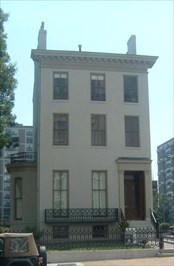
Greek Revival architecture in St. Louis is critically endangered. First, what is Greek Revival?

Here is an example from St. Paul, Minnesota. This is the more luxurious and less urban form of Greek Revivals.


Here's a New Orleans style urbanized form:


The uniting features of a Greek Revival are:

> A construction date between 1825 and 1860. In St. Louis, they were probably built until 1870, albeit in a transitional form suggestive of the successor--Italianate.

> An entry porch is typical. These are usually supported by columns (Doric on the first floor, Ionic on the second if multi-story). The columns have no bases--that was a feature added in the revival styles of the early 20th century.

> Sometimes, Greek Revivals have elaborate entries. Transom windows will surround the doors. A pediment (a blocky triangle) is very common and is a good indicator of a Greek Revival.

> Above windows and at the cornice line, a simple horizontal band usually exists. Sometimes, tooth-like "dentils" will be featured on the cornice. This is a holdover from the earlier Federal, or "Adam" style, which faded in most places around 1840. Some Federal townhouses can be difficult to distinguish from Greek Revival.

> Roofs typically have a low pitch or are gabled.

(Partial source: Virginia and Lee McAllester's A Field Guide to American Houses)

Greek Revivals are found all over New Orleans. That makes sense, since that city's major boom period occurred at about 1840, when cotton catapulted the city to heights of wealth unseen for a city its size. Greek Revival was the in-vogue house style at the time.

GR's used to be a common feature of the St. Louis landscape, though St. Louis saw its own zenith later on, past the Civil War. Neighborhoods east of Grand used to feature the occasional GR country home--miniature Greek temples. After all, the then-new republic wanted to amp up its connections with the foundations of democracy--Democratic Greece.

Neighborhoods like Old North St. Louis and Soulard as well as now-demolished Kosciusko, Mill Creek Valley, Lucas Place, and DeSoto-Carr were some of the city's oldest, and so could claim many of this then-popular style of home.


The Campbell House, circa 1851, is a later Greek Revival construction that is starting to resemble its cornice-heavy younger cousin, the Italianate. It is the last remaining structure from Lucas Place. At least it's incredibly well preserved.

Recognize this one? No, it's not New Orleans...


It's the 1848 Chatillon-DeMenil House in the city's Benton Park neighborhood--almost sacrificed (needlessly, obviously) for Interstate 55 right-of-way in the 1960s.

Other Greek Revivals in St. Louis were not so lucky.


Those above were located on the south side of Market Street between Jefferson and Beaumont [Source]. This was Mill Creek Valley, mostly constructed around the Civil War. Mill Creek had many late Greek Revival structures before it was completely demolished in 1959.

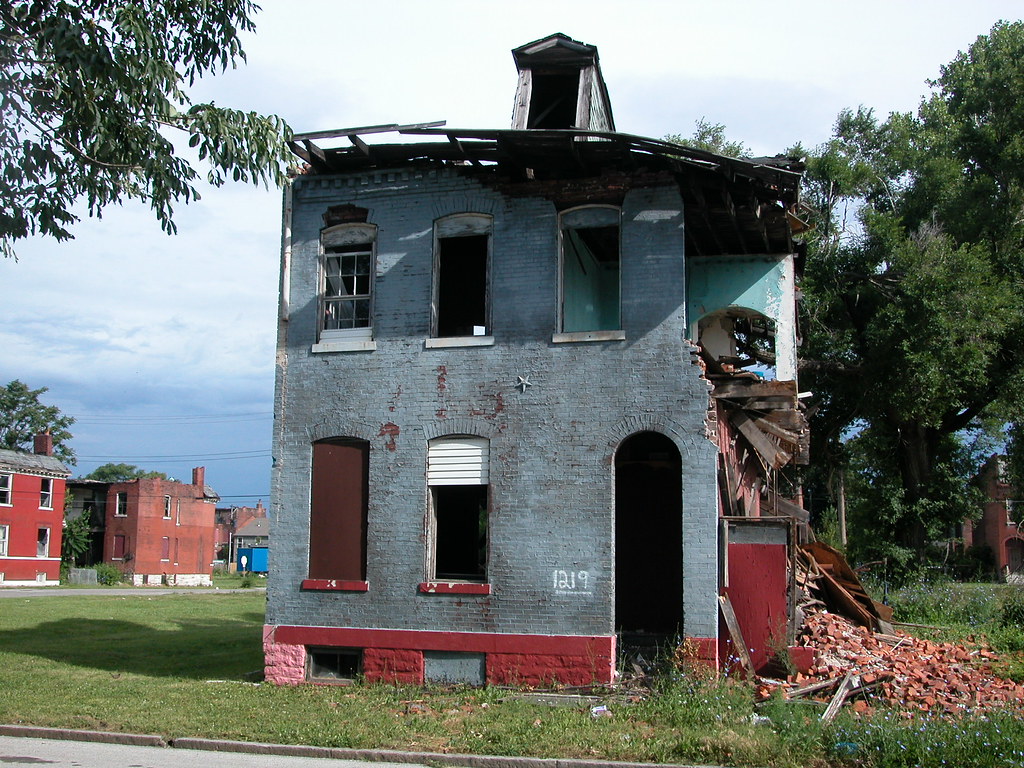
Ecology of Absence ran a great post a couple weeks back about a north side Greek Revival in its death throes. Michael Allen's picture of the home is below:


Says Allen:

The poor old house at 1219 Clinton Street in Old North St. Louis may be headed toward the end of a long death cycle. The beautiful side-gabled brick house is one of those Federal or Greek Revival-inspired row houses that lines streets in Old North in the middle 19th century. Prior to the popularity of the Italianate and Second Empire styles in the 1870s, and with materials like tin not widely available for ornamental cornices, builders tended toward a restrained, elegant form. These houses had segmental arches or flat (sometimes arched) stone lintels over doors and windows. They were two stories with an attic in the roof. Cornices were usually simple dentillated rows or wooden boards with beading or other patterns. Mostly tenements, these houses had gallery porches in back with staircases leading to second floor flats. Amid dense blocks, with buildings attached, mouse holes opening to gangways were necessary to allow for the passage of residents to and from the streets.


Part of the reason for the diminution of the Greek Revival stock in the city has to do with its Great Fire in 1849, where a lot of said structures downtown were wiped out. The other main reason is that urban renewal during the late 1950s and early 1960s destroyed most of St. Louis's oldest remaining neighborhoods. Planners of the time wanted to rid of Soulard as well, one of the only remaining areas of the city with any notable concentration of the house style.


Here is a Soulard Greek Revival, located at 1019 Shenandoah.


View Larger Map

Here is an Old North example, on the 2500 block of Blair:


View Larger Map


Unfortunately, the increasingly rare St. Louis Greek Revival is not receiving the level of protection it needs. The city and its mayor sit in the sidelines as McKee systematically destroys the last of them--and so many other styles--all within some of St. Louis's oldest neighborhoods. Just in case you fell out of habit of checking Rob Power's Daily Dose of Blairmont series, we're on Day 155!


Okay. So most of the structures remaining in the neighborhood are either transitional structures with more Italianate (heavy cornices with brackets) or Second Empire (mansard roofs) features. But many date to the end period of Greek Revival fame--and they share its quiet, often subdued urban elegance.


We should be identifying our remaining Greek Revival resources and protect them under an innovative arrangement--a local historic district that is non-contiguous, scatter site. If not, they will nearly all be lost, save for the grandest of them or those protected already by local HD's.

Monday, July 28, 2008

Back from St. Louis

What a greet weekend and another nice trip back to St. Louis.

I made it over to the Stable on Cherokee for some pizza, but that was my only experience at a brand new place. I did hit up perennial favorites Sameem's on South Grand and Blues City Deli in Benton Park. All were excellent. The Stable's space is particularly impressive.

One of my favorite parts was giving one of my mother's friends a tour of the whole city (but mostly north--she's from and still lives in South City). She doesn't leave her neighborhood too often and told my mom she'd like to go driving around and see the city when I got back in to town.

It was a great experience for all involved.

One moment of humor came when Mom tried to pretend that she knew the St. Louis history I was spouting off.

As we passed the Blairmont-owned former Schnucks site near Cass just north of downtown, I began to explain what the Kerry Patch was before I was interrupted by Mom.

Mom: Oh, I know what that is!

Friend: What is it, then?

Mom: It's when...a patch of people...came down to St. Louis...from Kerry, Indiana!

She said it so proudly, as if she'd really gotten it correct. Kerry, Indiana! Hah...there's a Gary, but is there a Kerry?

More on my trip back later. As always, forgive me for the hiatus from posting when I make my returns home.

Sunday, July 6, 2008

Hypocrisy in north St. Louis

This from the Post-Dispatch regarding Bob Cassilly's Cementland (a 54 acre 'amusement park' in an old cement plant's grounds in north St. Louis):

Cassilly has floated vague ideas for the site for years, but was forced to reveal his plans a month ago after St. Louis and the village of Riverview ordered Cassilly to stop work on the property. The site straddles both cities, but to no one's surprise, Cassilly never obtained permits from either. Meanwhile, his crew built a large castle on the property where Cassilly's children would play during visits.
[Emphasis mine]

Isn't it funny how someone else's acres of ordinance-breaking demolition by neglect gets a free pass from the city; but a man who is engaging in some real and creative economic development for the city is caught sans permit pretty handily?


Hmm...

Monday, June 23, 2008

My latest rants: for once, in brief!

#1

Why, why, why, why, why, why, why tear down more of Laclede's Landing? Did the original footprint of our once booming river city harm the City, or the Lumiere Casino, or something? In a better St. Louis, a whole intact row of Switzer buildings would stand in place of Lumiere, gleaming all the more brightly without all of the same annoying to-do.

#2

Please, Built St. Louis, no more! The Daily Dose of Blairmont series on Rob Powers' blog continues well past the century mark, now on day 108. Unfortunately, it's been about 7X that many days since the mayor or McKee himself should have addressed residents with their plans.

#3

Really, SLU, your new law school couldn't have wrapped behind the now gone Lindell manse?

This is not brain surgery, city leaders. Places that speak to a human scale are bound to be reclaimed. Why would we ever think of destroying these things when we cannot, or will not, replicate such scale?

Wednesday, June 4, 2008

Mayor's Chief of Staff indirectly reveals that Blairmont has "major plans"

"This is the first guy who's gone up there with major plans in fifty years."

That is KMOX's Charlie Brennan quoting Mayor Slay's chief of staff Jeff Rainford, defending McKee's activities on the near North Side.

The broadcast is a couple days old, so this isn't news per se, but the quote bears repeating.

This is the first official (albeit secondhand) announcement that McKee actually has plans for the area. Now, we all expected the same. And they are apparently, as we also imagined, "major". But is it not the worst smack in the face to hear that the Mayor indeed has known McKee's plans for some time but has not said so much as a sentence to ease the minds of his worried constituents?

This is poor, conservative leadership in a city that needs bolder change.

Simply applying for whatever awards come up for "redeveloping cities" and aggressively campaigning for these PR opportunities is not enough, Mayor Slay. The citizens of St. Louis deserve to know what McKee's plans are and to be included. Our built environment should never have been so intentionally chipped away at.

Ironically, the whole to-do over the World Leadership Forum's award to St. Louis for "urban renewal" was predicated on rehabilitation of historic buildings. Former lead St. Louis Planner Rollin Stanley entitled the presentation "From Vacancy to Vibrancy". Both Slay and Stanley seemed to suggest their leadership brought about all the new rehabber activity in the city of St. Louis. It wasn't mentioned that the Mayor had nothing to do with the writing of the historic tax credit act in the late 1990s (pre-Slay) that is the actual reason for the newfound "vibrancy". It was also not mentioned that Slay and/or the Board of Aldermen not only presided over but had a major role in the dismantling of Gaslight Square, McRee Town, Bohemian Hill, the Century Building, and now the Blairmont neighborhoods.

That's a lot of neighborhoods to have joined the lengthy list of demolished neighborhoods in the relatively short span of Slay's two terms. And yet, he's at it again, promoting St. Louis's being named a finalist in the 2008 All-America City Award (dubbed the "'Oscar' of Community Recognition"). Interestingly, the "St. Louis Region" is up for an award typically given to cities, and occasionally to counties. Still, Slay is willing to accept credit for regional innovations such as the Great River Ring.

All I can say is I am happy I kept my voter registration in Missouri!

Monday, June 2, 2008

Preservation Directory has published my post on Paul McKee and the Blairmont scheme!

Hopefully this will give the story a bit more national exposure! Check it out at Preservation Directory's preservation blog, listed under "Endangered History".

Here is my earlier post with an excerpt.

Awesome! I wish they had accepted my later edited version though. Oh well.

[Oops, by the way. I fudged on the beginning of McKee's buying spree--saying 2006 rather than 2003. And McKee owned more than 500 parcels even on April 25, 2008, at the time of my writing. Ah well, hopefully it stirs someone up nonetheless!)

Monday, May 12, 2008

Police Department on Blairmont: "Are you meaning to accuse them of arson?"

Last week, I called the St. Louis Fire Department to see if they had read any of the bloggers' coverage of the arsons in Blairmontland. I wanted to see if they were aware of what we preservationists, community developers, and concerned residents all are: that Blairmont owns a lot of property in the arson-afflicted areas, and that they have a history of illegal demolitions and otherwise severely neglected property. The arsons might, in fact, be a cheaper way of realizing the slow process of demolitions that has occurred already.

The STLFD referred me to the St. Louis Metropolitan Police Department. A detective (remember--I don't do names. I wrote down the phonetic spelling this time, but left it at work) returned my call today while I was at work.

Essentially, the conversation in my cubicle quickly became a trial of my logic and a defense of Blairmont. Also interesting was that the detective was fully aware of who or what "Blairmont" was, sometimes referring to the company as a "he" (Paul McKee, Jr.?). Read on.

As usual, this is NOT an exact transcript, just my memory of the exchange. If that sounds altogether too shaky for you to accept, feel free to disregard the post. I was pretty fired up (pun truthfully not intended), so a lot of what was said was burnt into my otherwise wont-to-falter memory.

Me: "I was just calling to see if the Police Department was aware of the owners of the property in that string of arsons last week in north St. Louis, because the Blairmont holding companies own almost all of them."

Detective: "Blairmont doesn't own them all, but, yes, we are looking into the case. Does that settle your question?"

Me: "Well, Blairmont owned nine out of eleven. That's a significant percentage."

Detective: "Well, they own a lot of buildings in the area, so that makes sense" [he laughs]

Me: "The LRA owns even more property, and not a single one of their buildings was burnt."

Det.: "Look. This city experiences arsons quite often. Are you suggesting Blairmont is committing arson? That's a pretty bold claim."

Me: "The arsons just happened to occur in the area that Blairmont is speculating within. Plus, there were eleven. I have been tracking the Blairmont companies through several websites and blogs. They routinely empty out occupied properties. At best, they remove the boards from the windows and at worst they seem to summon illegal brick rustlers. I fully believe that the case is pretty strong against Blairmont. They have an awful track record."

Det.: "I have been on the force for 14 years. These fires are not that uncommon. We've had problems with properties being vacant for years, long before Blairmont. And we've had a problem with arsons long before Blairmont too."

Me: "Well, then, let me ask you: in your 14 years, how often have 11 buildings been put up in flames in the same neighborhood in one night?"

Det.: "It's happened at least two or three times."

Me: "Two or three times doesn't seem like a lot to me. I'd say that this is a pretty suspicious occurrence. Especially when you consider that Blairmont has to take action by June in order to collect on a tax credit act he secured for land acquisition up there in north St. Louis."

Det.: "Why would he burn the buildings? That ruins the brick. Brick rustlers wouldn't want them burned."

Me: "To my knowledge, the fire helps separate the bricks from the wood so they're ready to be stacked and carted away."

Det.: "That's not my understanding. I have to disagree with that. The bricks get charred."

Me: "Well, I'm just stating what I've read on some architecture websites and blogs. Plus, the arsons make for cheaper demolitions, do they not?"

Det.: "I don't think so. I mean, the owner still has to clear away the rubble. I think it might cost more to do it that way."

Me: "I don't have the numbers on that, but I've always thought it would be cheaper to have a fire take down a building, along with brick rustlers, than it is to hire a demolition contractor to take down 75 acres worth of buildings."

Det.: "I don't think so. I think the owner still pays for all that."

Me: "Well, even if you're ready to dismiss that Blairmont might have started the fires themselves, you have to treat Blairmont properties as especially dangerous considering how often they're subjected to brick rustling, demolition by neglect, and arson. Even if it is coincidence, you have to look at the fate of each one of his buildings. They're falling down. One blogger has taken photos for the past 70 days of Blairmont properties. Like clockwork, after Blairmont gets to them, they're turned into rubble and brick rustlers get to them. Seems a little odd to me. If I were conducting an investigation of the arsons, I'd be suspicious of Blairmont. I'm not saying that it's a clear and demonstrable fact, but there is certainly enough circumstantial evidence to warrant an investigation, I think."

Det.: "I have to prove. I can't go on that kind of evidence. So you're wanting to accuse them of arson. That's pretty bold."

Me: "Blairmont has shown such a demonstrable lack of care for its properties in north St. Louis that it's hard to ignore what's happening. I would suggest you visit the blog I'm talking about. It has pictures--before and afters and stuff."

Det.: "What is it?"

Me: "builtstlouis.blogspot.com"

Det.: "Well, I will look into this. Thanks for calling."

Me: "Yeah. Thanks for your time."


The detective's tone bordered on mockery. It sounded as if he was tasked with deflecting public criticism and scrutiny in light of the strong case one could make against Blairmont.


If the St. Louis Metropolitan Police Department is not outraged by the endangerment of city residents enough to further investigate (perhaps indirect) foul play by Blairmont, what hope do any grassroots groups and citizens have to fight the urban renewal scheme--or at least involve themselves in it?


Sure makes you wonder.

Fashion STL Style!

Fashion STL Style!
St. Louis Gives You the Shirt Off of Its Own Back!

Next American City

Next American City
Your Go-To Source for Urban Affairs

Join the StreetsBlog Network!

Join the StreetsBlog Network!
Your Source for Livable Streets

Trust in Rust!

Trust in Rust!
News from the Rustbelt

Dotage St. Louis -- Blogging the St. Louis Built Environment Since 2008

Topics: Historic Preservation, Politics and Government, Development, Architecture, Urban Planning, Urban Design, Local Business, Crime and Safety, Neighborhoods, and Anything Else Relating to Making St. Louis a Better City!