
First, that renovation, at 12th and Gravois just adjacent to the monstrous I-44/I-55 interchange: it's great!
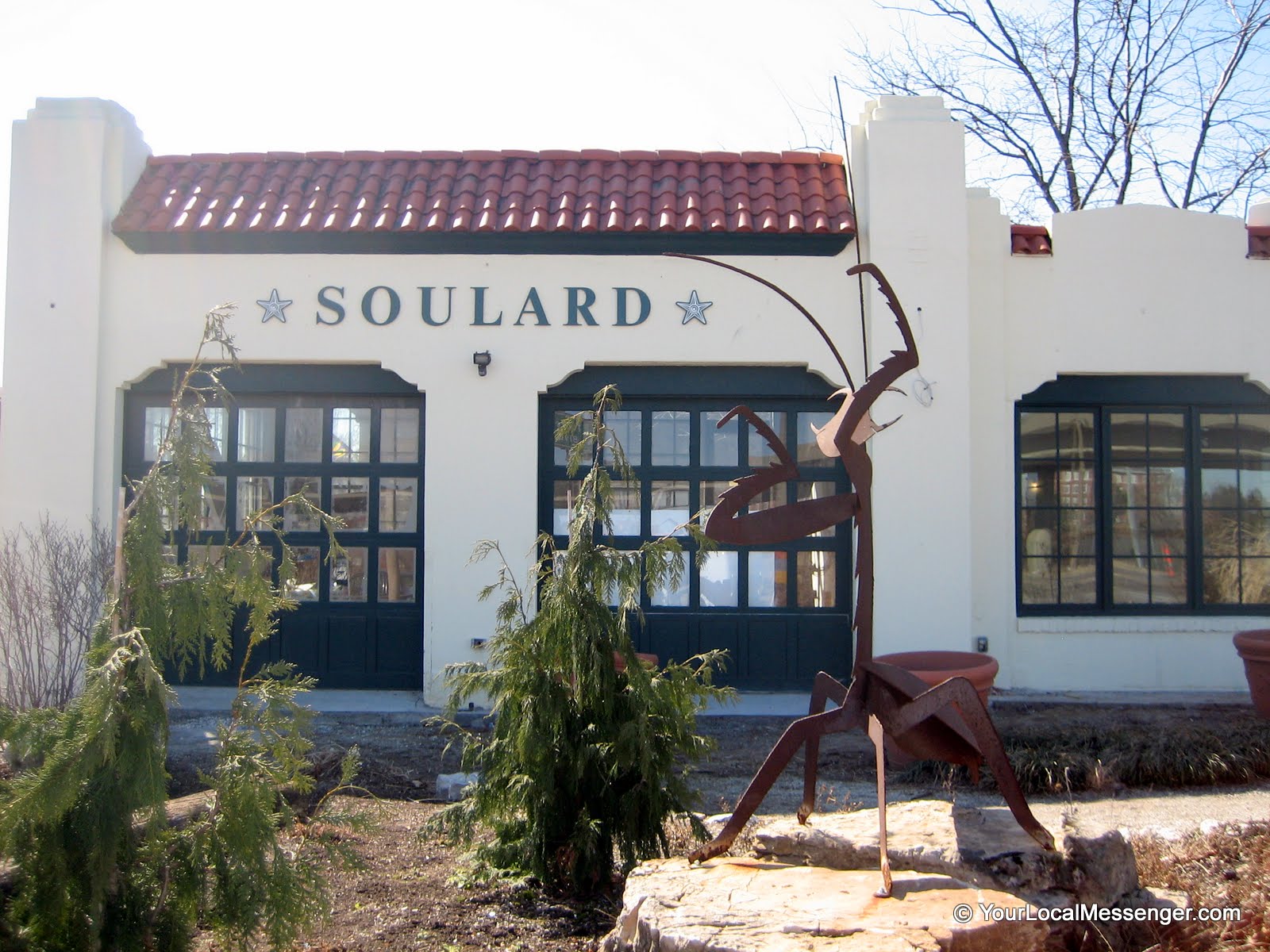
Photo credit: The Messenger
Instead of a large paved lot at a highly visible intersection, we now have a renovated and attractive old gas station structure fronting a lushly landscaped triangular lot. This is a win for the city. The building itself looks to be of that 1920s or '30s Spanish Colonial vintage and is now safe from demolition. The paved lot that made it such a detractor to the cityscape is now a contributor to the neighborhood's beauty and a much better gateway.
Sure, a corner hugging, triangular-shaped building would have been ideal, but this is still a victory in my book.
The City of St. Louis would do well not to wait around for successes like that shown above in Soulard. Public policy can influence what becomes of parcels formerly dedicated to gas stations (and other autocentric uses). It can also regulate new ones in a way that benefits the city and its residents.
To the first point: St. Louis has lots of gas stations. Way too many for a city of its current size and any realistic future size as well. The history of the fueling station, of course, extends back to the early 20th century, when cars first made an appearance in cities. Because car ownership did not reach levels of ubiquity until after World War II, early fueling stations were often small, having one or two "bays" for refueling at most. Even more interestingly, the architecture of the gas station (yes, gas stations once involved design beyond the level of stacking cinder blocks) was often meant to match the surrounding neighborhood in residential contexts, or possibly play on current architectural styles. This is why Soulard, a 19th century red brick neighborhood, saw the construction of a Spanish Colonial 20th century fueling station--that style was in vogue at the time. If you need an example of a gas station meant to "fit in", look no further than Brannon and Pernod in the Northampton neighborhood:

In a neighborhood chock full of charming "gingerbread' Tudor Revivals, this gas station adopted the same design motif.
In most cases, I believe these historic gas stations should remain, even if they're not the most urban in form and allow a gap in the streetscape. They're often attractive and can even host other uses, such as retail or even restaurants. This gas station at January and Eichelberger in Princeton Heights contained a florist for a long while. I'm not sure that it's still open, but it still goes to show that these buildings can be reused. It may even be worthwhile to list all of the city's historic fueling stations on the National Register of Historic Places under its Multiple Property Submission (MPS) format.
But the most important policy should go towards future (and current) gas stations operating as gas stations. The city needs an ordinance limiting the number of pumps at gas stations. Such an action should be coordinated with a reexamination of zoning. In certain areas of the city--such as the long, autocentric stretch of South Kingshighway between Arsenal and Tholozan--larger gas stations are less obtrusive. Their lights don't shine into neighboring houses, bringing down property values. Their multiple curb cuts and constant stream of traffic do not disrupt pedestrian flow quite as much as other, more residential areas.
I think it would make sense to limit the number of pumps at each gas station in more residential areas to six pumps, or three bays. Along with the limit, there should be absolutely no liquor sales. Liquor makes gas stations very profitable--and therefore lucrative--enterprises. There should be only one curb cut per station. In addition, each gas station should have urban design guidelines--as should every new building in the city of St. Louis. The city should look to close (via eminent domain?) several gas stations due to their extremely negative effects on surrounding property values, crime, light and noise pollution, pedestrian hostility, and general aesthetic concerns. One such target should be the Grand and Gravois station adjacent to the South Side Tower redevelopment. It's an eyesore and destroys what could be a picturesque corner that would stabilize its surroundings (I'll do another post on fast food restaurant regulations...). All gas stations, current or proposed, should have to comply with stiff landscaping regulations, replete with many trees and flowers--not just small hedges. Signage and lighting should be shortened and softened, respectively. Each station should have to obtain a special operating permit, whose overall number should be capped at a sensible number and distribution. Licenses should never be awarded to adjacent gas stations.
Gas stations are a noxious, but necessary use in a city. As such, they should be present, but limited. They should be fewer in number, more expensive than suburban stations, and better designed in truly urban environs. Removing some incentives (such as liquor and lottery sales) and adding regulatory measures to stations (landscaping, special permits, etc.) would accomplish these goals.
You might be asking: well, can you really make a gas station attractive? Take a look at these modernist gas stations, which I find highly appealing.
The Netherlands:

Sacramento, California: imagine this one with some landscaping.

See more examples here.
We should be demanding a more attractive, walkable environment for the City of St. Louis. Today's crop of gas stations simply misses that mark. Better and more regulations would make sure current stations are retrofitted...or even that older, smaller stations are reused while newer, larger, and uglier stations are closed and redeveloped into something more urban. The worst that could happen to the city by enacting legislation would be that gas stations would find it less profitable to operate in the city and would focus on the periphery. To me, that's a worthy sacrifice.
Smaller gas stations across the city that have been vacated have been transformed, many for the better. Community gardens and green space are becoming increasingly popular re-uses for former gas stations sites, as was done in Lafayette Square (at Dolman/Park). New residential construction has arisen in Fox Park atop an old service station (Russell/California), while Washington University student housing is being proposed for an old auto repair shop in the Loop (Eastgate/Delmar). These are all positive uses for former gas stations or autocentric sites; public policy in St. Louis should be pressing for more success stories like these.


