Search This Blog (A.K.A. "I Dote On...")

Tuesday, November 17, 2009

Gate District Hodgepodge

The Gate District, while sometimes maligned by the urbanist set for its decidedly suburban new construction, has plenty of surprises befitting of the most urban of neighborhoods. I am not sure if I have ever witnessed a neighborhood so randomly interspersed with new homes, vacant lots, and historic ones as the Gate District.

Check out this block of Caroline Street in the Gate District.

From the scene below, and with more judicious cropping, one might assume the block is characterized by smallish classic red brick homes with some nice, if faded brick sidewalks to match.


The next lot to the west, though, is vacant and lacks any sidewalk.


Moving to the west just one more lot and we have one of those "suburban" intruders, with its tidy new concrete sidewalk.


In just three urban lots, we have urban, rural, and suburban settings. We have historic buildings, new construction, and no construction.

Say what you will about the Gate District, but it's full of interesting bits and pieces. If you're unfamiliar with the area, check out Floral Row, Diner's Delight, the SLU Medical Campus Urban Prairie, the Barr Block of historic Second Empire rowhouses, the Christian coffee shop in a rehabilitated circa 1867 Lutheran Church, the Theresa School, and much, much more.

I don't hear it referenced very often, but the Gate District is the product of the planning of superstar New Urbanist Andres Duany. Read more on that here.

Saturday, November 14, 2009

Conflicting Goals on Southwest Avenue

In the October 2009 Communicator Newsletter, the Southwest Garden Neighborhood detailed plans to re-do the streetscape along Vandeventer and Southwest Avenues.

Components of the project include upgrades to the pedestrian signals, crosswalk, and traffic signal timing at the intersection of Kingshighway and Vandeventer, implementation of a road diet along Vandeventer (reducing traffic lanes from 4 to 3, excep at the main intersections), installing new street lights with cut-off fixtures (which will reduce light pollution and increase lighting for the pedestrian), increased plantings of low maintenance ground cover and hardy tree species, reduced curb-cuts, and ADA-compliance.
Sounds great--and very necessary, right?

While I'm unsure of the boundaries of the project, it's nevertheless disheartening to see that a portion of Southwest Avenue may soon lose its urban charm and become less friendly to pedestrians even as another section of the road sees an upgrade.

Favazza's restaurant, located at 5201 Southwest, is seeking demolition permits for two neighborhood commercial/mixed use buildings, at 5209 and 5211-13 Southwest according to the latest preliminary Preservation Board Agenda.

These are the buildings in question:


View Larger Map


The full report is not yet online, so the reasons for the requested demolitions are not yet available (anyone want to call Favazza's and ask?). The best guess is, of course, a nice and spacious adjacent parking lot.

Unless the ultimate proposal is new construction on site, which I doubt, Favazza's plans to tear down two pedestrian-oriented buildings on a stretch of road soon to be improved just doesn't make sense. Again assuming a parking lot is coming, the result will be a less walkable, uglier street.

The Hill and adjacent Southwest Garden are thriving St. Louis neighborhoods. Especially in the case of the former, the record has shown that small, storefront retail with limited parking leads to a more walkable and walked neighborhood. The Hill's commercial rows are interesting--and lively for St. Louis, which is mostly starved of the brisk pedestrian traffic of denser cities in the Northeast.

Tearing down two buildings on a strip with major potential is an all around bad idea. Yet it's even less bearable when you consider the waste of public investment in making roads pedestrian friendly and then removing all the reasons pedestrians would ever want to walk them.

I think to Martin Luther King Blvd. from Jefferson to Grand as an example of a pure waste of money whose improvements only brought more attention to the sorry state of buildings along the stretch. The city and some private owners have worked together to strip most of the refurbished street and its sidewalks of any urban buildings that make walking interesting and comfortable, that give small business owners a chance to invite the pedestrians to the stretch in the first place. See what I mean?


View Larger Map
Here, new streetlights and sidewalks only cast light on the emptiness of the surrounding blocks.

My argument is not that disinvested places or streets with few urban buildings do not deserve to have better sidewalks; it's just that there should be a special effort to justify such investment. In other words, keep these roads as urban-formatted and pedestrian friendly as possible! Keep the remaining buildings in place; assign an urban design overlay zone that is very restrictive with regard to parking lots! Simple as that.

The Preservation Board should deny the ridiculous demolition proposals on Southwest Avenue. You may voice the same opinion at the monthly meeting, to be held:

Monday, November 23, 2009
4 p.m.
1015 Locust
Suite 1200

Please show up and protest bad, if typical land use planning in the City of St. Louis. See to it that our commercial corridors are ripe for reinvestment and pedestrians, not drivers and visual blight.

(My apologies in advance if Favazza's is experimenting with radically amazing new construction on site of these two fine buildings and is not, as I suspect, shooting for a parking lot).

Thursday, November 12, 2009

Southampton Neighborhood's Macklind Business District Gets Cool Metal Banners

Via the September 2009 Southampton Newsletter, these babies will soon be appearing on Macklind:


Great! I love to see such great evidence of St. Louis's unending neighborhood pride.

Tuesday, November 10, 2009

The History of Parking

The National Building Museum in Washington D.C. is playing host to a fascinating exhibit: the history of parking in the United States.

A Washington Post article on the exhibit pulls out a few interesting, if not altogether surprising points: parking lots used to be rare and parking structures were once given design consideration.

Yet the modern era that emphasized architectural honesty and a bold break from classicism admired the repetitive geometry of the concrete garage. It emboldened architects to highlight, rather than hide, increasingly large structures dedicated to that ultimate symbol of American progress and freedom--the automobile.

From the article:

There was an era, says Sarah Leavitt, curator of the National Building Museum show, when cities took pride in these structures. But that pride, based on the sense that a modern city couldn't progress without adequate parking, hid a darker indifference to the historical fabric of the city. The exhibition also includes before-and-after shots of a block of F Street NW, showing the loss of two historic buildings to a hideous parking garage built next to the Hotel Washington. It also includes an image of one of the most notorious parking garages in the world, the Michigan Theater in Detroit, made by slamming concrete decks into the shell of a classic and beautifully ornamented movie house. To this day, people still park there surrounded by the ghostly architectural shadow of a building once meant to please and delight.

In St. Louis, many of us are well aware of the history of parking. Parking garages--and other autocentric uses such as automobile showrooms--used to be housed in urban, street-fronting buildings. We saw this in the old Livery Stable on Locust in Automobile Row--demolished by SLU in 2007 for, ironically, a surface parking lot.


Livery Stable in the foreground. Photograph courtesy of VanishingSTL, which ran an excellent piece on the Livery Stable demolition here. Note how the Stable contributes to the urban streetscape; now it's a parking superblock.

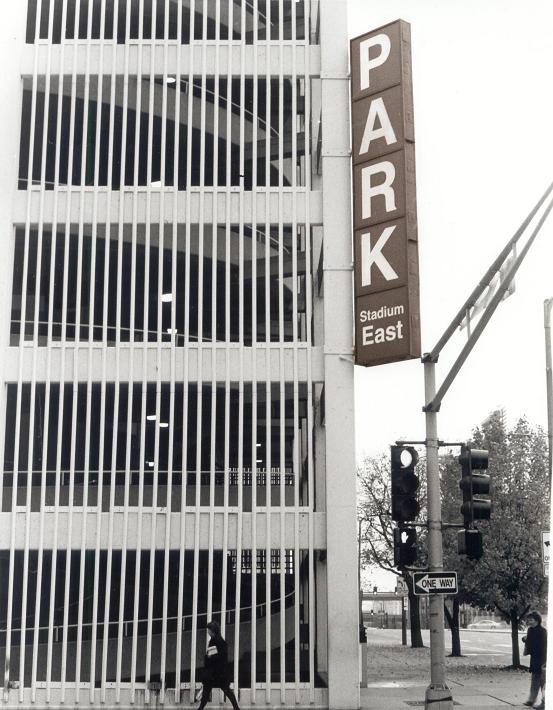
The modern era in St. Louis was much as described above in the Washington Post article: architects boldly ripped out the historic built environment for oversized concrete garages. Of all the buildings that have been demolished in downtown St. Louis since the 1950s, parking garages are rarely among those targeted (if ever?). Some of downtown's dreariest and most life-sucking uses remain modern-era garages that must come down to create lively streetscapes.

Public Enemy Number One, in my opinion, is the outright hideous and, frankly, embarrassing presence of the Busch Stadium garages.


Who doesn't feel sorry for the pedestrian that has to walk a whole block beneath the hulking presence of one of the Busch Stadium garages? To think that they bookend the proposed Ballpark Village development, too! Clearly, in order to have an active "village-like" atmosphere, these horrific garages should go. Likewise, urbanists often lampoon Kiener Plaza for its supposed lifelessness; yet it's the hideous Kiener garages that flank the civic plaza that lend the space so much drear and droll.

In another urban planning and design disaster, the 1896 Century Building was destroyed to create a parking garage that mocked the original piece of architectural splendor. Detractors rightfully called it "Garage Mahal". This 2004 garage clearly retreated from the attention-grabbing antics of its modern predecessors (if for no other reason than the controversy over the Century demolition). Yet, somehow, its presence is only slightly more "welcoming" than Busch or Keiner.

No, by the way, street-level retail does not always mitigate parking garages ugliness. Something about the permeable nature of garages makes them uncomfortable for the pedestrian; they're open; the wind blows through, as if they were vacant, windowless buildings. Their concrete structures are usually heavy and foreboding; their nightime orange glow menacing.

The saga continues in St. Louis. Instead of getting Pyramid's "Mercantile Exchange" retail district with a restyled St. Louis Centre, we're now getting a parking garage with street level retail. While this deal may be preferable to a standalone, completely ugly and unadorned parking garage at the old Ambassador site as was originally proposed to placate downtown lawfirm Thompson Coburn--it's a far cry from good planning. Downtown has too much parking; each garage makes downtown a little less interesting and less walkable.

The history of parking in St. Louis, especially downtown, could have supplied the National Building Museum with plenty of material. Recall that the site of the Gateway Arch sat as a huge surface parking lot for decades (from the early 1940s all the way to the early 1960s), marring the riverfront and totally disrespecting the original site of the colonial city of St. Louis.

Despite lessons learned since then, St. Louis is still building parking garages for each new development, reducing their urban appeal. There's a recently completed garage at Tucker and Clark; look for new ones to rise with the Kiel Opera House redevelopment as well as the Municipal Courts Building. And those are all contiguous blocks.

As I've argued many times on this site, St. Louis needs a parking plan for its downtown and a zoning code that emphasizes the importance of pedestrian activity and safety over that of vehicular ease of access. With sound planning, the "future of parking" should be a much less lengthy story than its past.

Monday, November 9, 2009

Beautiful Block in Gravois Park


View Larger Map

While Gravois Park may be more known for its early 20th century, mostly preserved streetscapes, the eastern portion of the neighborhood closest to Jefferson retains some late 19th Century charm. The above block--3700 Texas--contains quite a varied and interesting collection of vernacular St. Louis architecture dating as far back as the 1860s, perhaps.

It has several Second Empire micromansions, some vernacular Creole cottages, some simple red-brick Italianate structures, and more. Scroll the block to check it out; it's a charmer.

Thursday, November 5, 2009

Would Bus Ridership Increase...

...if the bus stops looked like this?


Source: Planetizen, via The Design Blog

Instead of rusting in a junkyard, these decommissioned school busses contribute to the urban streetscape and busrider comfort.

Metro's Arts in Transit program's director should consider contacting the artist.

Speaking of Arts in Transit, the Poetry in Motion program seems intriguing. I'm assuming (it's not explained on the website) that these poems and the graphics that accompany them adorn the sides of busses and possibly Metrolink cars as well.

This poem, by Mary Ruth Donnelly, was my favorite:


Bringing art and life to transit will only endear people to it. Well done on both accounts.

Tuesday, November 3, 2009

Downtown St. Louis Needs a Parking Study

A parking study and plan for downtown St. Louis, backed by an ordinance that would adopt the findings and enforce them as law, could have prevented the demolition of the Ambassador Theater, the Century Building, and more.

A friend of mine from Providence, Rhode Island who now lives in St. Louis recently commented to me that he could not believe what downtown St. Louis had demolished for parking lots and garages, even since the 1990s. "Providence would have never done this," he said of the woefully misguided razing of the Title-Guaranty Building on the Gateway Mall. As many others have observed, vibrant cities hold onto human scale buildings and architectural diversity because they contribute to urban life. Supplying more spaces for cars creates convenience for drivers alone--not the route to urban revitalization.

A recent planning-related article I read put it simply: if you plan for cars, you'll get traffic; if you plan for people, you'll get people.

Without offering up a potshot at Culinaria--recently under fire for reportedly leading to the closure of several businesses downtown--the Century Building fiasco should have been the city's final wake-up call. Losing human scale, mixed-use buildings--or foregoing the opportunity to erect these buildings--should no longer be an option for downtown St. Louis. I'm confident that a parking study would reveal downtown is oversupplied. A complementary downtown parking plan could target city-owned garages for removal, or city-owned surface lots downtown (are there any?) that could be used for development.

A consulting firm well versed in urban planning and transportation planning would call for a ban on the construction of any parking-only building until the study was next updated (10 years?). We all know, and yet I feel compelled to repeat, that each parking lot and garage is an incentive to drive. For those that feel downtown parking is a pain and feel that parking garage rates are inflated given the oversupply of spaces downtown, it's an incentive to avoid downtown altogether. A sound parking plan would be, conversely, an incentive for public transportation ridership, for biking, and for walking. This translates to a more active, walkable, and walked city.

(See my St. Louis Beacon piece from last year for more thoughts on how parking-abundance hurts livable cities.)

Cary, North Carolina (outside of Raleigh) has a parking study that I stumbled across while doing research for work. While I've not delved into it too deeply, it intrigues me that a suburban community would look into determining parking deficit/surplus. When city government pledges to help each downtown law firm, etc. build its own adjacent parking garage, does it even ask this basic question?

Cary Parking Study Analysis

To see more of the Cary Study's documents, click here.

When will downtown St. Louis have a strategic parking plan? The answer is, almost assuredly, when "we" write it.

Fashion STL Style!

Fashion STL Style!
St. Louis Gives You the Shirt Off of Its Own Back!

Next American City

Next American City
Your Go-To Source for Urban Affairs

Join the StreetsBlog Network!

Join the StreetsBlog Network!
Your Source for Livable Streets

Trust in Rust!

Trust in Rust!
News from the Rustbelt

Dotage St. Louis -- Blogging the St. Louis Built Environment Since 2008

Topics: Historic Preservation, Politics and Government, Development, Architecture, Urban Planning, Urban Design, Local Business, Crime and Safety, Neighborhoods, and Anything Else Relating to Making St. Louis a Better City!