Search This Blog (A.K.A. "I Dote On...")

Wednesday, March 3, 2010

Charlotte and St. Louis / Change and Gentrification

Every once in a while, something so cool comes out on the interwebs that it simply must be bookmarked and spread to others who will appreciate it. I guess this is the essence of the "viral video".

The video shows Charlotte, North Carolina in its pre-growth spurt at the late 20th century into the current century--and beyond. The rapidity of change in Charlotte is almost frightening. This reminded me of how slow St. Louis's physical change has been over the past 20-30 years. Sure, quite a bit has been demolished, but not a lot has been put back in. Our video below would certainly be less flashy and interesting using the same time period. But has its social landscape shifted as rapidly; has it been gentrified?

As a quick reminder, City Affair will be discussing Gentrification at its monthly meeting tomorrow, Thursday, March 4, 2010 at 7:30pm. The location is the STYLEhouse at 3155 Cherokee Street, the new digs of local clothing maker STL-Style. For a link to the event with more information, including speakers, please click here.

But if you'd like to watch Charlotte evolve, click below now. Thanks to Kaid Benfield of the Natural Resources Defense Council for covering this on his blog! Full-screen, with sound, would be best.


Metropolis by Rob Carter - Last 3 minutes from Rob Carter on Vimeo.

Tuesday, March 2, 2010

Mayor Slay Talks LRA Successes, but Cites a Failure

Mayor Slay's blog, MayorSlay.com, is host to a variety of discussions about city politics and development as well as general announcements from City Hall.

Recently, Mayor Slay took to explaining how LRA works in a three part series. You may read each section here: Part One / Part Two / Part Three.

This blog appreciates when an elected official--or his staffers--take the time out to explain circuitous processes of governmental agencies. I will note that I think all of what was in the Mayor's posts should be clearly laid out on the LRA's web site. But at least we attentive ones now know.

I was most interested in the third part of the series, explaining LRA successes.

In this portion, the Mayor mentions that the LRA worked with the Guardian Angels Daycare Facility to sell them a vacant commercial row for their newly constructed facility on North Vandeventer at Finney. I don't count this as a success--at all. See below.

This is the building that was demolished, via a blog post at Ecology of Absence entitled "Commercial Rows Fall on Vandeventer":


The handsome Italianate row occupied only the far northeastern corner of a large group of parcels eventually controlled by Guardian Angels.

Now take a look at the replacement:


From an urban design standpoint, we've steered straight off a cliff. Why--at the very least--could Guardian Angels not have used the facade of the old building as its face to the city? Proper urban zoning should have made the new structure's setback illegal anyway. But now we have a building with all the architectural charm of a QuikTrip occupying the spot of a reusable North Side commercial building. I realize the costs would be higher to preserve and stabilize a facade, but the public benefit of a more pedestrian-friendly facility and a preserved historic street wall would go far. The surrounding Vandeventer neighborhood is quickly becoming another St. Louis urban prairie; buildings like the former 1121-33 N. Vandeventer lent a sense of character and stability to the struggling neighborhood, even in their vacancy.

It's also worth noting that Guardian Angels could have built around this building, given their land-wasting suburban site plan. But the LRA is connected in no way to urban planning and design. Mayor Slay himself says that the LRA tries to preserve all buildings located in a city historic district, but this Vandeventer site isn't even protected by preservation review, much less a historic district.

Here the Mayor hits upon an important point: the only time our urban landscape receives any planning and design considerations is when a piece of land is inside a historic district. Historic preservation activities should not be a city's only legal teeth to demand a better, more urban built environment. Our city deserves comprehensive planning so mistakes such as this Guardian Angels building do not occur across the cityscape.

The point is illustrated further by Mayor Slay when we read that the (two) aldermen representing the surrounding neighborhoods are attempting to recreate a former commercial district (Sarah-Finney) atop a series of LRA-owned vacant lots. See them here, on Finney, on the Google Map.

Why try to recreate a commercial district when you've just trumpeted the demolition of a crucial piece of that former district? If the building were preserved, the LRA could have helped Guardian Angels to construct a new facility on the commercial street that is to be resurrected. In ideal terms, there would have been urban design guidelines in place as well. The old Italianate row could have been spared and used as part of the commercial district reconstruction.

These kinds of senseless decisions happen when you have a vacuum of urban planning and such decentralized leadership (note that two aldermen are involved, not one).

This may be a success in the broad term of "development", but, to me, it shows a failure of the LRA to integrate their activities with urban planning and design.

But not to Mayor Slay, who says:

None of these new developments – or others — would not be possible if LRA did not thoughtfully administer the land parcels under its control with a vision for the best possible bright future for our neighborhoods. That’s why LRA has the policies it has.


I respectfully disagree.

City to River Group Hits the Local Media


KMOV (Channel 4) has covered the City to River group's proposal to tear down a portion of Interstate 70 soon to be redundant with the construction of a new Mississippi River Bridge. Watch their coverage above or read the transcript here.

The only problem is that they failed to explicitly mention this--that I-70 will be rerouted over the new bridge and that a new at-grade, urban Memorial Drive would not be replacing I-70 at all in any official capacity. KMOV opened by labeling the proposal a "radical idea".

Also, the reporter interviewed a MODOT official who claimed the agency had "severe reservations" about removing any portion of I-70. See the video above. MODOT is open to tunneling the depressed lanes of the soon-to-be-former I-70, but not demolishing the whole 1.4 mile stretch in favor of an urban boulevard.

Where do I begin?

Removing a redundant piece of an interstate is not a "radical idea" in my book. The transformation of the area would be radical in the physical sense, if that was what was meant. But the notion itself is rather, well, sensible. The Archgrounds International Design Competition is underway and has provided funding for making better connections to the Arch and surrounding neighborhoods--not just the four blocks where the depressed section runs. It makes sense to remove the barrier between Laclede's Landing and the rest of downtown and to create a nexus of activity in the Memorial's center. An urban Memorial Drive would pull visitors from Laclede's Landing southward and allow them to much more easily, and with much more urbane surroundings, reach the Gateway Arch and Old Courthouse.

Furthermore, as mentioned, the new Mississippi River Bridge will carry the new I-70 route, which will now enter the city of St. Louis at Cass Avenue rather than the Poplar Street Bridge. Funding is in place and the bridge is being constructed. Now is the time to capitalize on the fact that this 1.4 mile stretch is simply redundant and not needed. Current plans indicate that MODOT will simply rechristen the old I-70 lanes as I-44, extending it northward from its terminus at I-55. To me, it's a radical idea not to remove this ugly barrier at such an opportune time.

Now for MODOT. How exactly is any 1.4 mile stretch of road absolutely necessary to the region's transportation network? Okay, maybe turning I-270 into an urban boulevard would be a ridiculous proposal, but a small run of a road at the convergence of several interstates? That's a bit of a different proposal. There's simply no way of arguing that a new Memorial Drive with even a 30 mile per hour speed limit could not accommodate traffic attempting to travel the 1.4 miles to either I-55 or I-64 from the new I-70 landing at Cass Avenue.

At an average rate of even 20 miles per hour (factoring in a stop light or two and clear traffic), it would take just 4.2 minutes to make it from one end of the new Memorial Drive to the other. Trucks heading northbound from I-55 could choose to either cross the river twice to reach I-70 without using surface roads or simply proceed north on Memorial Drive.

Our region has an incredibly dense network of interstates for its size. Some urbanists, including me, believe more than just this 1.4 mile segment of I-70 should be studied and considered for removal as well. (How about looking into reconnecting Soulard and Benton Park by "boulevardizing" I-55 from Lemp to the Poplar Street Bridge? Now that would be in the realm of "radical".) But that is for another time. City to River's proposal is smart and sensible, looking to improve our city at a low cost to all us, who'll enjoy the project's many benefits.

The New Memorial Drive, at Spruce looking eastward toward Busch Stadium.
Image Courtesy of City to River

Favazza's is Tearing Down Hill Commercial Building

 UPDATE (2/3/10 @ 8:35am): I encourage readers to check out the comments on this post. Anthony Favazza has responded and clarified some points and views reflected on this post. The plans for the two commercial buildings referenced below are outdoor dining, not parking, and may result in less parking. Still, the Hill has lost one historic commercial building already and may lose another soon. In my opinion, outdoor dining areas should not take the place of whole buildings. That's what sidewalks are for. 


Also, apparently the Cultural Resources Office can approve a demolition permit in a preservation review ward without sending it to the Preservation Board. So that explains how both Favazza's and Olympia demolished nearby buildings without the public being able to comment. The original post follows:

In a scenario that has become all too common in the City of St. Louis, a restaurant is taking down an adjacent building to provide more parking.

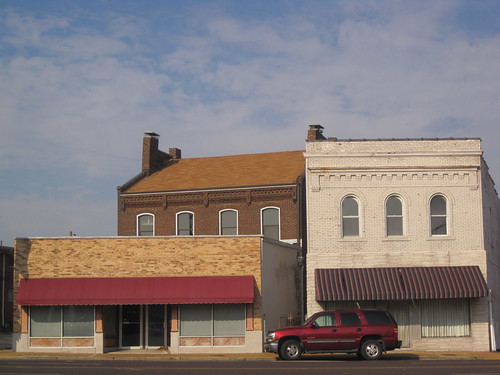
As reported back late last year on this blog, Favazza's on the Hill sought demolition of two commercial properties on Southwest Avenue--5209 and 5211-13 Southwest.

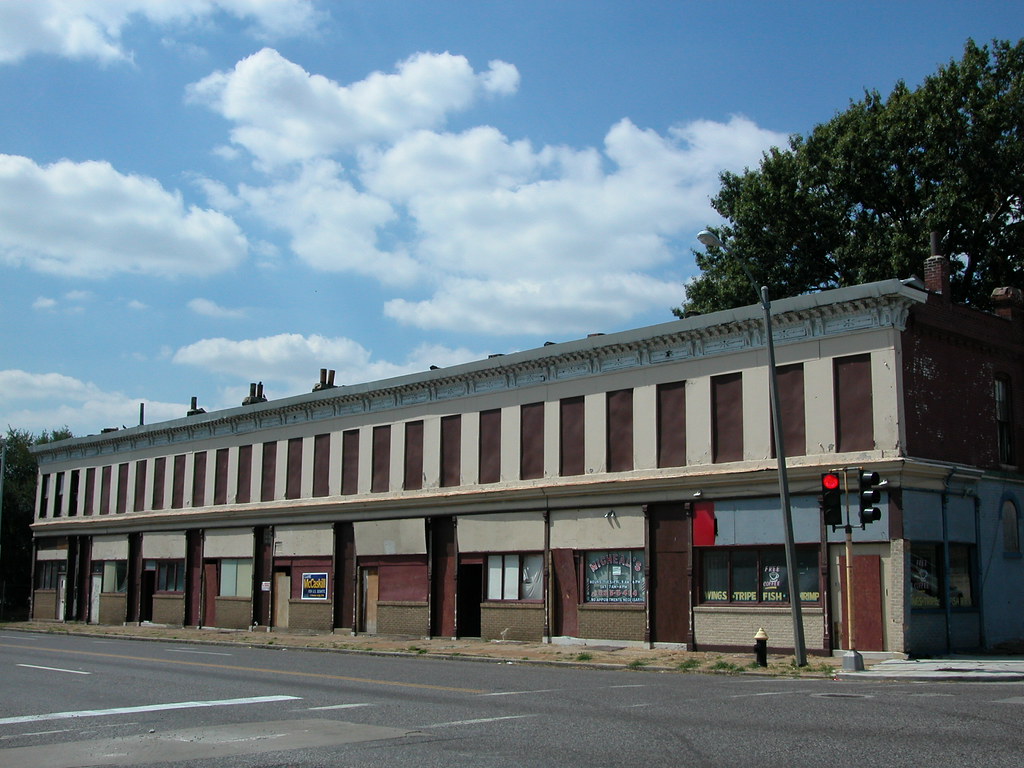
The two buildings are pictured below, courtesy of Michael Allen at Ecology of Absence.


Matt Fernandez is reporting via the Urban St. Louis forums that 5209 Southwest, the white building (on the right) above, is partially demolished already, with its second floor having been removed. Just as a note, this could be an attempt to renovate and stabilize the building, as John Favazza informed this blog that the building suffered a roof collapse at the rear after a storm in 2006. The reason I say this is that Matt Fernandez noted that the second floor facade is still intact.

However, Favazza also informed this blog that he definitely had no intentions at all of saving 5209 Southwest, due to the extent of the damage, and that this site would become additional parking as well as outdoor dining space. Favazza stated that they consulted SPACE Architects, who said the building was not salvageable. So in all likelihood, this building will soon be completely erased.

The fate of 5211-13 is less certain. Again, when I spoke to Favazza, he said they may try to renovate the building and that I should check in for future plans. However, they applied for demolition permits for both buildings last August, indicating that 5211-13 is likely to disappear as well. The result will be a vast stretch of asphalt where urban--and attractive--buildings once stood.

I reported just a few days ago on Olympia in Dogtown demolishing two frame houses to provide more parking for their restaurant as well. What is going on here? Why let sound urban buildings languish in neighborhoods that could sustain more residents and businesses? We know the answer: parking, parking, parking! (And outdoor dining--but that could have been easily accomplished with a simple sidewalk dining permit). Both Olympia and Favazza's seemed to proceed without going before the Preservation Board. Each restaurant and their demolished properties are inside city "Preservation Review" districts. How they bypass measures to see buildings preserved for the public good is a mystery. Perhaps emergency demolition permits?

It's true that we can't completely lash out on the businesses themselves. They're being selfish, sure. They're being anti-urban, yes. But we can only expect exploitation to continue to occur when we have a broken system that encourages such deplorable stewardship of a sensitive built environment.

The City of St. Louis needs a proper 21st century urban zoning ordinance. We also need a Master Plan to direct growth and redevelopment. We need to more sensibly manage our resources and assets, assuring that we don't chip away at our commercial districts and put up unsightly, heat island parking lots where urban buildings and activity should be. It's past the time where urbanists need to get together to write such a code and initiate a Master Plan for this city. We need to comprehensively prevent senseless urban planning and design atrocities.

I would recommend calling and emailing 10th Ward alderman Joseph Vollmer. Please let him know people visit the Hill because of its unique charm and ambiance, not because of its plentiful parking. He should have shown leadership and offered Favazza's advice on how to not only provide its patrons with outdoor dining, but how to put these buildings back into use.

Monday, March 1, 2010

Rex Sinquefield Aims to Kill Taxes in Missouri: Will He Take Preservation Down with Them?

In yesterday's Post-Dispatch article "Big changes proposed for taxes," Rex Sinquefield defended his proposal to eliminate the state income tax and replace it with an expanded sales tax. Proponents of this method call it the "Fair Tax," as everyone pays the same tax rate on the same goods.

The provision, SJR29, would do all of the following (from the Post-Dispatch):

— Repeal state's 6 percent individual income tax, 6.25 percent corporate income tax and franchise tax beginning Jan. 1, 2012.

— Replace lost revenue with a greatly expanded and higher sales tax.

— Tax items and services that are currently exempt, including groceries, prescription drugs, medical care and K-12 private schooling.

— Eliminate all tax credits, such as those for historic preservation and maternity homes.

— Exempt business-to-business transactions, used goods and college tuition.

— Give all households a "prebate" to cover higher sales taxes on spending up to the poverty level.

— Require two-thirds vote by Legislature to enact more tax exemptions


At this juncture, I am most interested in the fate of historic preservation, one of Missouri's top economic development tools via the state tax credit for historic rehabilitations. Ridding of income tax means rendering tax credits useless.

Sinquefield notes that he actually supports historic preservation efforts and believes the tax credits should be replaced with "direct subsidies". I would like to ask him, how would this work? The state of Missouri's legislators have already attempted multiple times to eliminate the historic preservation tax credit altogether without the assistance of the Fair Tax proposal. Indeed, they have already placed restrictions on it, capping tax credits for larger projects. If the Fair Tax takes out those tax credits that were alleged to only benefit wealthy, connected developers, largely in St. Louis, who will be the unlucky one to try to introduce "direct" historic preservation subsidies?

I worry they would disappear forever--and with them, a city like St. Louis's chances for seeing large swaths of its aging built environment renovated as we saw in the 2000s under the current tax credit program.

I worry about other aspects of this proposal as well, including the effects on higher sales taxes on small, local, independent businesses and the possibility of people crossing state lines to avoid such higher taxes on goods.

The measure is headed for floor debate, possibly as soon as this week. If approved, voters would decide the ultimate fate of the bill in November.

St. Louis is Distinctive, but Not the Most Distinctive

As reported earlier on this blog, St. Louis was recently honored to be selected as one of the nation's "Dozen Most Distinctive Destinations" for 2010 by the National Trust for Historic Preservation.

For the first time ever, the Trust put the dozen destinations, which included Provincetown, Massachusetts and Bastrop, Texas, up to a popular vote to determine the Fan Favorite.

Marquette, Michigan is this year's winner, besting St. Louis by a considerable margin.

See the final results here.

Marquette will receive a free one-year partnership with Gozaic.com, a new website dedicated to heritage tourism.

The photograph, showing the Upper Peninsula 200 Sled Dog Race in Marquette, is courtesy of the National Trust.

Disrupting a National Historic Landmark

I don't usually dedicate an entire blog post to someone else's blog post, but the occasion calls for it.

Rob Powers of Built St. Louis has posted a provocative piece on the Archgrounds Redevelopment--AKA Framing a Modern Masterpiece international design competition.

Powers argues that the landscaping, while a nice photo-op, is not part of the city. He calls for the landscape surrounding the Arch to be built upon, restoring a street grid and "bringing the city back to the Arch".

It is important to note that both the Arch and its surrounding landscape architecture are listed as a single National Historic Landmark.

How would you feel seeing the reflecting ponds and other green space disappear in favor of an urban street grid?

In my own opinion, the grounds make for a masterful design of deferring to the Arch in every way. The sleek, modernist monument is almost elemental, rising out of passive green space just as sinuously as its curving pathways and reflective lakes.

That said, if an urban streetscape restoration were gradual and were highly invested, I don't know if I would much miss this reflective landscaping. I simply worry about the execution of any construction projects in our time. Craftsmanship and creativity are too often lacking, most markedly when juxtaposed next to our city's cache of historic buildings. Especially if such a project were to have too low a budget or be conceived and built by one developer/builder, I don't think the result would honor our modern masterpiece. I do believe in good, sound contemporary construction--but we would need something especially smart to defer to the silent grandeur of the Arch.

Besides that caveat, I simply doubt the National Park Service would ever go for it. What do you think?

Fashion STL Style!

Fashion STL Style!
St. Louis Gives You the Shirt Off of Its Own Back!

Next American City

Next American City
Your Go-To Source for Urban Affairs

Join the StreetsBlog Network!

Join the StreetsBlog Network!
Your Source for Livable Streets

Trust in Rust!

Trust in Rust!
News from the Rustbelt

Dotage St. Louis -- Blogging the St. Louis Built Environment Since 2008

Topics: Historic Preservation, Politics and Government, Development, Architecture, Urban Planning, Urban Design, Local Business, Crime and Safety, Neighborhoods, and Anything Else Relating to Making St. Louis a Better City!