Search This Blog (A.K.A. "I Dote On...")

Thursday, May 20, 2010

Downtown Dutchtown's Vital Signs Improving

Just a few short years ago, when I worked as an intern at Dutchtown South Community Corporation, a humble coffee joint (Java Joe's) and a pair of small antique shops were about all that a once vibrant stretch of Meramec Street could claim. The one true anchor of the business district was Winkelmann's Drug, a pharmacy open since 1913 at the southwest corner of Meramec and Virginia. Java Joe's closed for good soon after I completed my internship. While I'm not 100 percent certain, I believe the antique shops are by appointment only, or have random hours otherwise. The street was clearly not at its best.

Today, the story of Meramec, and the overall outlook of the street, is much different. A dedicated group, the Downtown Dutchtown Business Association, or DT2, is working to attract businesses to the neighborhood commercial district. So too is recently elected 25th Ward alderman Shane Cohn.

The Java Joe's space, and, I believe, another short-lived coffee shop, gave way to Urban Eats, Dutchtown's best little cafe and hangout spot. Urban Eats is cozy and has an innovative concept: couture wraps and pizzas. Their food is made to order and exactly to your liking, from the type of bread on up. They also have a really nice retail shelf of Dutchtown and St. Louis-related items. Urban Eats must be given credit for infusing Downtown Dutchtown with the right energy level and a sense of creativity and community all at once.

Urban Eats
3301 Meramec
314-558-7580
facebook.com/UrbanEatsCafe


Twice Blessed Resale Shop, across the street from Urban Eats, is a not-for-profit store run by the folks behind Our Lady's Inn, which serves homeless women in the St. Louis region. The staff is friendly, its wares somewhere between free and dirt cheap, and its profits help keep the shelter afloat.

Twice Blessed Resale Shop
3302 Meramec
314-481-3332


Another newcomer to Downtown Dutchtown is the Virginia House, an art gallery sheltered in a diminutive brick Dutchtown storefront that was vacant for quite a while.

UPDATE [5/21/10]: Reader Maude has informed this blog that the Virginia House is no longer an art gallery, but will soon be home to a boutique produce market, which will accept EBT and WIC! Awesome! Reader Dan tells us not to fret over Virginia House; they're looking to expand because their first two events were too big for their space! All around great news!

Virginia House
4219 Virginia
314-805-8026
Facebook Page


Pre-renovation shot, from their Facebook page.


And post-renovation, shot in artsy Polaroid, also courtesy of the Virginia House Facebook page.

Here's a nice photo of the outdoor gallery space as well:


The newest kid on the block, though, is Refabulous, a consignment shop. Definitely worth a visit for its incredible prices and great selection of men and women's clothing, the owners are delightful as well!

Refabulous
3314 Meramec
314-353-1144


I have a pretty trustworthy feeling that we'll see more movement on Meramec quite soon.

Friday, May 14, 2010

Building Better Blocks

The folks in Oak Cliff, Texas--a suburb of Dallas--have much to teach urban St. Louis about how to use its streets. (Digest that for a moment!)

The Better Block project in Oak Cliff did just that--made a forgotten little commercial corridor a much better block, if briefly. A team of artists and community activists set about reclaiming a stretch of one-way, car-friendly road that had a bunch of vacant but pedestrian-oriented commercial buildings.

They painted a bicycle lane, created faux-pedestrian lighting, received donations of plants for some on-the-go streetscaping, and even went so far as to install one-day-only "businesses" in each vacant storefront. A flower gallery, cafe, and children's art studio popped up on the stretch overnight. The point was to show what a narrowed, enlivened street that accommodated all modes of traffic (pedestrians, cyclists, and cars) could look like one day of the year so that residents could demand such an environment 365 days a year. The event organizers' wishes soon came true, as city officials soon expressed a desire to make the installation permanent. Several businesses leased the empty spaces immediately afterward as well!

Their fruits of their efforts, under a paltry $1,000 budget, were nothing short of spectacular. Here is a shot of a before (bottom) and after (top) of the bettered block:


You can watch the video of the street's metamorphosis below:


The organizers even left admirers with a "How To" guide for creating a better block in your own city...which is exactly what St. Louis should do. One of the best observations made by the Block Betterers is that the owners of the vacant space essentially get the most up close and personal marketing available. What a great way to generate interest in forgotten commercial districts across the city!

Of course, I got to thinking of where in the city would be most appropriate for such a project. The purpose of the project is to take a stretch of road that is highly visible and highly trafficked and return it to its original pedestrian-oriented function. (Cars are still allowed, albeit on a narrower, safer road).

Initially I thought of Olive Street just west of Taylor in the Central West End. It has many empty storefronts and could truly shine with the Oak Cliff treatment:


However, Olive Street has storefronts that have been vacant and sealed for quite some time. Just the task of getting the owners to remove the boards and make the properties safe for staging might be too much of a hassle. Plus, more importantly, the road is probably far too quiet and off the beaten path to make the same impact as shown above in Dallas. (As a plus, though, the south side of Olive appears to have pedestrian lighting already in place. Yes, I said only the south side. The north side of the street falls within another ward. Sigh. Another plus is that nearby Bowood Farms could donate some trees for streetscaping.)

So after giving it a bit more thought, I think I found the perfect spot.


That's a shot of Gravois Avenue at Victor Street. This stretch has a series of mixed use and commercial buildings not unlike the Dallas road. Gravois is a high-speed road, incredibly visible, and yet, in this strip, is still largely intact.

Imagine the above scene with a two-lane road in place of six. A green bike zone clings to each side of the road; historic street lamps adorn an artificially expanded sidewalk; trees and shrubs soften the industrial grayness of the street. The Dallas team included lots of artists, and Good Citizen Art Gallery, already extant on Gravois, could take the opportunity to make this temporary re-do of its host road something of an outdoor art exhibit. The strip already has a bakery, with Bittersweet Bakery, and a recording studio, Shock City Studios, among other businesses, so the pressure to create fake, one-night-only businesses is lessened. Yet, of course, there are still enough unfilled storefronts to change the dynamic of this part of Gravois from expressway to true urban business district.

So what do you think? Who's willing to put a St. Louis Better Block project together? If you agree with me, and think we should take over a block of St. Louis, let's get started!

Thursday, May 13, 2010

Preliminary May Preservation Board Agenda Includes Demolitions, New Bike Rack

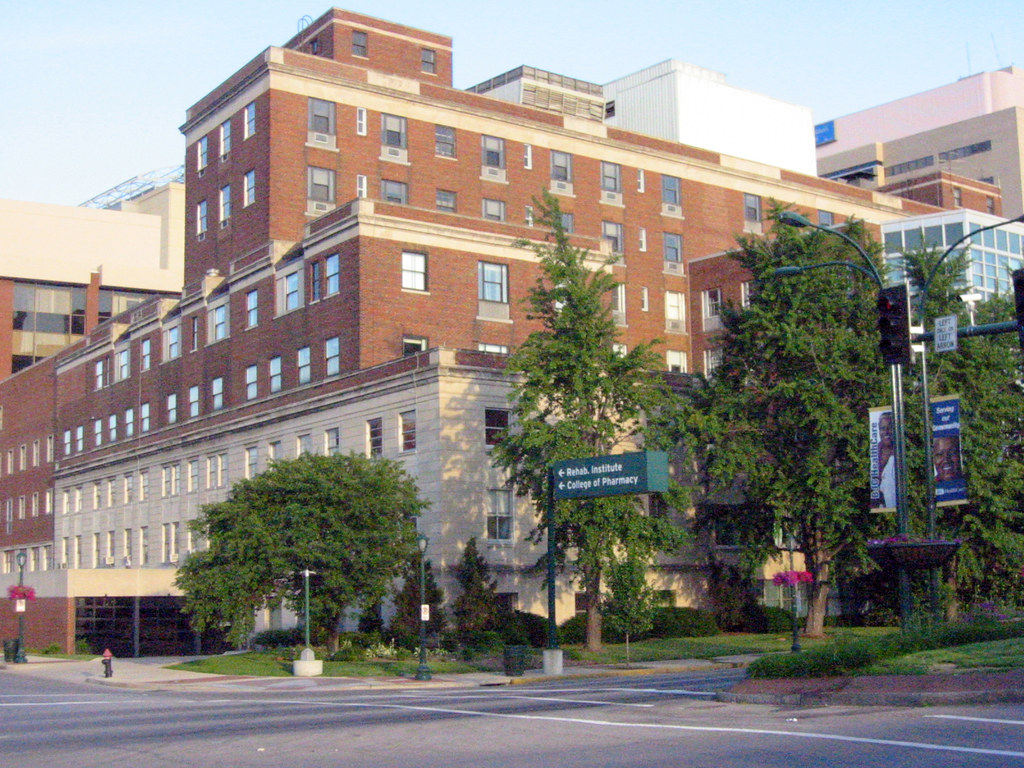
On the latest temporary Preservation Board agenda, BJC Healthcare is seeking the demolition of two buildings for a new patient care center. The addresses are 4948 Parkview Place and 329 S. Kingshighway. These are the old Jewish Hospital buildings.

Vanishing St. Louis warned us of these proposed demolitions back in February of 2008. Here is a picture that author Paul Hohmann snapped then:


I am against a proposal that calls for the demolition of fine old buildings just to create new buildings that are blandly deferential to the monochromatic "campus" aesthetic. For Washington University's Medical Campus, this means a beige building with blue glass. No thanks, if that's the plan.

Also on the agenda is a proposal to install a five-foot tall Eiffel Tower sculpture doubling as a bike rack outside of new Lafayette Square cafe Rue Lafayette.

Also in Lafayette Square, there is a proposal to construct a home on the vacant lot at 1117 Dolman. My old block of Dolman appears to being doing well. Just south of here, the Preservation Board has granted approval to single-family home construction on another grassy lot. By a Google Streetview survey, yet another large empty lot on Dolman has a sign with some model homes on it further down the street. Maybe Dolman can soon mirror the success of the rest of the neighborhood with sensitive infill consuming its unfortunate gaps.

A new single-family home will join this row soon, if approved by the Preservation Board in May.

See the temporary agenda here.

As always, I encourage readers to attend Preservation Board meetings and testify for the items for which they are passionate:

The St. Louis Preservation Board will meet on May 24th, 2010 at 4:00 P.M. in the Cultural Resources Office of the Planning and Urban Design Agency, 1015 Locust Street, Suite 1200.

Monday, May 10, 2010

A Survivor in St. Louis's "German Quarter" Hangs On

Even in a city with a lot of German heritage to speak of, St. Louis's Patch and Carondelet neighborhoods stand out. A separate city until annexation by St. Louis in 1870, the city of Carondelet indeed has its own storied past. It is so important to the city that absorbed it due to its unique architectural cache. The oldest parts of the Carondelet and Patch neighborhoods show contemporary St. Louis what its oldest neighborhoods once looked like prior to demolition in the post-war period. Small colonial homes by new German arrivals in 1840s Carondelet closely matched their French counterparts in portions of St. Louis closest to downtown. There is one major exception, though, which is the use of limestone as a building material. German Carondeletters preferred this striking material for their building facades:


This home, at Vulcan and East Marceau in the Patch, is known as the Schlichtig House, constructed in 1852. As you can see from this Google Streetview capture, its environs today are less than urban. This was not always so.


This 1945 capture shows the Schlichtig House at left with a fine row of neighbors, including another couple stone houses that may have been built by the Schlichtig family as well. (You may see more photographs of this area in the National Register of Historic Places "Carondelet - East of Broadway" Multiple Resource Area nomination).

Industrial expansion in this historic area of St. Louis (nee Carondelet) has claimed a lot of architectural lives. The Schlichtig House holds on, as do dozens of other homes dating to the same era in this battered part of the neighborhood. What can be done to preserve them?

The city of St. Louis asked this question twice, once in 1967 and again in 1973. The former was a St. Louis Riverfront Plan, while the latter was a St. Louis Development Program planning document. Both called for the majority of historic buildings to be moved to a protected site north of industrial territories. Their notion was to recreate the old village of Carondelet. While this might even today sound inauthentic and misguided--and certainly historic homes lose a part of their historic significance when removed from their context--I now wish it had happened then.

Far too many of these simple stone houses have been lost; few would be appreciated anyway without a self-consciously didactic arrangement of such homes as proposed in 1967 and 1973.

Now, with the nearby River City Casino complex up and running across the River des Peres in Lemay, Carondelet is seeing some development attention. Is now the time to buy up historic Carondelet stone homes and move them to safety in a series of protected blocks? History buffs will recall that Carondelet developed the nickname "Vide Poche", meaning empty pockets, due to its gambling houses that sent St. Louisans home empty-handed. Since River City has restored this historic function to the neighborhood by its very proximity, can we bring back Vide Poche as well? Is it time to dust off plans long ignored?

Why not, especially if such a plan would save this beauty in the 7700 block of Vulcan?


I wouldn't want to live in this splendid c. 1850s row house where it sits today. Were it moved, I'd love to snap it up. Moving historic buildings can be a touchy subject, but if our options are slow decay-in-place or success in mobility, I choose the latter.

Friday, May 7, 2010

The Loss of a Historic Building May be a Win for the Neighborhood

When, exactly, is the above statement true?

When, and only when, the replacement of the historic building is a thoughtful, well-crafted one that advances the neighborhood. Vacant lots and out-of-scale shoehorns need not apply.

6323 Arthur in Lindenwood Park (also known as the Linden Heights subdivision) was a small, frame front gable home in disrepair. In a neighborhood noted for its stability and high levels of owner-occupancy, the vacant, deteriorating home definitely stood out.

6323 Arthur, before. Courtesy of Geo St. Louis.


Today, the site is home to new construction (by Blue Brick Construction). I feel the replacement meets our simple litmus test outlined above. The small frame home could have been restored with careful TLC into something quaint and yet affordable. But the replacement solved its vacancy and solidified this neighborhood all at once. Would this infill look good in Benton Park West, replacing a solid red brick four-family? Of course not. In Lindenwood Park, it manages a persona that is both classy/traditional and, subtly so, sleek/contemporary.

 6323 Arthur, after. Photo courtesy of Blue Brick.

Is this the best case of a net positive historic preservation tradeoff? Maybe not. But I enjoy this infill and am happy the little home on Arthur did not die in vain.

Wednesday, May 5, 2010

Open the Streets or Close Them?

St. Louis Open Streets kicked off on May 1. Most accounts of it call it a qualified success; qualified in that there could be several improvements the next go-around. A shorter or different route? Better advertising? And how to handle speeding cyclists? The success part comes from showing St. Louisans their city from afoot and doing so from the normally dangerous space where fast vehicular traffic usually courses. It's a great respite for a pedestrian. No curb cuts to worry about; fewer opportunities for collisions, and pedestrians and cyclists all around.

 Open Streets, on Locust Street, in downtown St. Louis. Photo courtesy of St. Louis Energized.

At the same time Open Streets were debuting in St. Louis, a road long closed to vehicles was anticipating a reunion with them. North 14th Street in Old North St. Louis now has curbs and bare tree wells; a paved street, which will allow cars for the first time in almost 40 years, will appear soon.

14th "Street" is starting to look the part! Photo courtesy of Old North St. Louis.


So which is it? Should we "open" or "close" our streets? Notice the cross-definitions here; 14th Street was closed to vehicles in the 1970s whereas Locust, Manchester, and Lindell, among others, were opened to pedestrians on May 1.


I say we do both! Open Streets is a great event that should become a semi-regular thing. Hosting it too often stifles the mystique to participants who find it a novelty to be able to walk calmly along major roads. Without constant programming, such events will inevitably thin out.

While most observers regarded Open Streets as a progressive move by the city and by the event's sponsors, so too is the long awaited re-opening of 14th Street in Old North advancing our city. The strange irony is that, for the benefit of pedestrians, cars should be on a lot more streets in St. Louis than they currently are even encouraged to go. An urban, traditional street grid works best because it gives the pedestrian and the motorist multiple options for making the same trip. This has implications for the sauntering pedestrian who might stumble upon a new corner store that she'll then patronize regularly as well as the emergency vehicle whose driver can choose to bypass a busy intersection's bottleneck by maneuvering down some minor streets. (Whenever we urbanists complain that tourists or suburbanites or who have you never see the "real" St. Louis, we need to realize that the city is hiding its best assets behind road blocks and private streets).

While closing off streets with barriers and bollards and such seems like a great idea for pedestrians, it actually renders streets semi-private and much too quiet for comfort.

Restoring St. Louis's street grid by re-opening streets to through-traffic (I'm looking at you, Forest Park Southeast, Shaw, and others!) will bring about connections that are currently unrealized. The fewer disruptions in both pedestrian and vehicular transportation networks, the better. It gives us all more options and allows us to more easily and more safely explore and traverse neighborhoods.

Our major roads could see traffic eased up a bit as drivers filter into neighborhoods now considered, unjustly, "off the beaten path". Combined with Complete Streets legislation, recently introduced in the City by Alderman Shane Cohn, these major streets could better accommodate pedestrians trying to use/cross them as well! This would be an equitable network that could encourage pedestrian-oriented development on all roads while simultaneously not restricting vehicles--except on those exciting, every-once-in-a-while Open Streets events!

We need to re-assess policies that keep vehicles from winding through our great quilt of neighborhoods, because a lot of explorers and admirers would otherwise arrive on four wheels. Confining noise, traffic, and pollution to a handful of large arterials is only doing a disservice to our city. These streets (Kingshighway, Natural Bridge, Grand, etc.) become the face of our city to most; and not even a great street like Grand is without its unforgivably autocentric gaps. We can change this by depressurizing the stress we put on these few roads and opening the grid to all. Close the streets to any and all vehicles a couple times a year? Sure! Otherwise, open them all up to everyone.

Open the streets and close them!

Saturday, May 1, 2010

So You Think Southwest City is Boring?

I've heard it said before by many a St. Louis urbanist: southwest St. Louis, with its tidy rows of gingerbread Tudors and neo-Georgian colonials, is "quaint" at best. It's boring at worst.

Those that desire the red brick ambiance of the city's older innards will not be disappointed by Southwest Garden--a neighborhood that stretches to Hampton Avenue on the west, which is surely an urban-suburban demarcation in the minds of some. (For many, that boundary is anything west of Kingshighway, or even Grand).

Southwest Garden is an incredibly architecturally diverse neighborhood. The eastern section of the neighborhood, east of Kingshighway and south of Vandeventer, is mostly brown brick multi-families with Craftsman or even Spanish Colonial detailing. The subdivisions just west of Kingshighway have some larger homes in the American Foursquare, Romanesque, and Classical Revival styles. There are even two International style houses on Kingshighway itself within the neighborhood. The rest of Southwest Garden is home to frame shotguns that clearly belong to the Hill neighborhood's housing stock; tract houses built in the 1950s; "bungaloids" of the 1920s; and the aforementioned Tudors and Georgians that changed the landscape of St. Louis post-World War I but pre-modernist fever.

I like neighborhoods with a diverse housing stock, and St. Louis has some of the most variation within and between neighborhoods that I've ever witnessed in an American city.

Just a short three blocks from Hampton Avenue--the encroaching suburban ethos is palpable--sits the 5600 block of Reber Place. No, this isn't the part of Reber with the tree-lined median that you'll find just west of Kingshighway. We're talking really close to Hampton, here, folks!

It's my favorite block in the neighborhood. This block rests, humble and demure, allowing "cooler" South Side neighborhoods their unfounded disdain. It's no matter, though; 5600 Reber's quiet confidence is there for those that appreciate it.

Southwest City is not boring. If it is, it certainly doesn't look the part. If you need more than architectural evidence, I'll now point you to the Luminary Arts Center and the TreeHugger installation in Southwest Garden. Oh, and Sandrina's.

Fashion STL Style!

Fashion STL Style!
St. Louis Gives You the Shirt Off of Its Own Back!

Next American City

Next American City
Your Go-To Source for Urban Affairs

Join the StreetsBlog Network!

Join the StreetsBlog Network!
Your Source for Livable Streets

Trust in Rust!

Trust in Rust!
News from the Rustbelt

Dotage St. Louis -- Blogging the St. Louis Built Environment Since 2008

Topics: Historic Preservation, Politics and Government, Development, Architecture, Urban Planning, Urban Design, Local Business, Crime and Safety, Neighborhoods, and Anything Else Relating to Making St. Louis a Better City!