Search This Blog (A.K.A. "I Dote On...")

Tuesday, April 1, 2008

No way!

Suburban developer McKee purchases St. Louis City Hall, Arch
by LAN D'GRABBE (Associated Press Writer)

ST. LOUIS, Mo. - Two iconic St. Louis buildings are part of a major purchase of land made by Paul McKee, Jr., a suburban St. Charles County developer. St. Louis City Hall on Tucker Boulevard and the famous national landmark the Gateway Arch were purchased by the developer, along with several other high profile public buildings including the Civil Courts Building, the Soldier's Memorial, and most of the St. Louis Loft District along Washington Avenue.

An associate of Mucker, LLC. (named for the Market Street and Tucker Boulevard intersection where City Hall is located), who bought the properties for a combined total of over one billion dollars, could not be reached for comment.

Mayor Francis Slay, a Democrat, lauded the purchases Tuesday.

"This is a great burden lifted off of the city," he remarked. "No longer will the city be unfairly pegged with maintaining anything--whether it be residential, commercial, public, or civic buildings."

Residents expressed concern over McKee's new holdings, arguing that his track record of land purchases in north St. Louis should have precluded him from undertaking such large responsibilities as the city's main governmental building and its chief tourist attraction, the Gateway Arch. Several buildings owned by McKee's associated LLCs have rapidly deteriorated, some stripped of their bricks and other decorative materials prior to emergency demolitions.

Mayor Slay said of such skepticism: "Well, this is the Show Me State. I don't know what McKee's plans are for these buildings, but I trust him. I'll sign on as soon as he shows me."

Asked if he is worried that St. Louis landmarks will be stripped of their architectural details and eventually bulldozed, Slay stated, "No. City Hall was built in 1898--it's old--and is a prime location for a publicly subsidized parking garage or suburban subdivision. And the Arch has lost its luster--it's about time we slapped some vinyl over it."

Monday, March 31, 2008

For what do we sacrifice our mid-century marvels?

As demolition of the Doctor's Building is complete, and the threat of the San Luis Apartments demolition grows more tangible, I just have to ask one question regarding the targeting of mid-century architecture and what ultimately replaces it: why?


In the case of the Doctor's Building, the new denizen of the site will at least be urban in form and keep a mixed-use presence on the site, even filling in the land on which the parking lot that the Doctor's Building originally claimed for its own construction rests. But concerns over why the building had to be demolished at all remain, as well as doubts about the quality of the design of the new project. Michael Allen wrote a beautiful essay on the Doctor's Building and another on his qualms about the proposed development over at Ecology of Absence.


In the case of the San Luis Apartments, (or crazy, funky mod building with three compound fractures, if you will) the St. Louis Archdiocese intends to turn the site into a surface parking lot. Vanishing STL has more on their plans to establish a "campus" where now only a "hodgepodge that happened over time" exists with regards to buildings. Those are the words of our spiritual leaders, folks. Check the full story out here.


I might add, on a bit of a tangent, that this "campus" mentality is what fuels St. Louis University to rid of its own troublesome "hodgepodge" and seek a unified, faux-Gothic appearance punctuated by green space. It's as if the city and its neighborhoods are once again canvasses from a time of urban renewal, where blocks can be closed, buildings torn down, people uprooted, churches and institutions drained of their members, and once active urban spaces with the potential to be such again reduced to parking lots and garages--all in the name of creating a logical "campus". It's a mortifying confirmation of SLU's and the Archdiocese's view of the city and their respective roles within it--that the city's complexities, those that render it interesting and unpredictable and urban, can be done away with in order to produce a sterilized, definable, controllable, and marketable "place."


Any Mid-Century Modern proponent should look further back to what is St. Louis's perhaps most egregious abuse of land in a direct violation of what neighborhood residents originally demanded. Look no further than the northeast corner of the intersection of Chippewa and Kingshighway, where four neighborhoods and a whole lot of pedestrian and automobile traffic converge.


This was what the corner used to convey when the old Famous-Barr Southtown store was constructed in 1951. Though its massive scale and caustic materials may have hurt its chances at recognition as "historic" in the 21st century, there is a lot to commend about this structure, demolished in 1995. In typical streamlined modern fashion, the building adhered to a classical form while showing it up on the massing and using bolder materials. That is, this building has great respect for this large and heavily trafficked corner with its dramatic curvaceousness. It commandeered this intersection with its very presence, so much so that one barely notices the gas station in the foreground. Combined with the northwestern block of buildings of this intersection, this is unmistakably an urban neighborhood.


Fast forward to 2005, and construction has been completed on a new commercial strip center over the site of the old Famous. The result is a dreary and awkward design that can't even compete with the suburban counterparts it has attempted to emulate. One of the outbuildings abuts Chippewa, albeit about eight feet above it, and shows its backside, literally and figuratively, to the passers-by below. A Walgreens store occupies the parcel closest to the corner, but with a spacious row of parking and a non-sensical triumphal arch/bus shelter(?) that urges the otherwise overlooked pedestrian to jog across a parking lot to purchase wares that can be found in an identical store in Des Peres or dozens of other St. Louis suburbs.


The neighborhood fought a K-Mart store that was interested in the 11 acre lot in the late 1990s and early 2000s. The "Southside Coalition" headed by John Klevorn pressed for an urban, mixed-use replacement to the felled Famous. Per an April 5, 2000 Riverfront Times article:


[14th Ward Alderman Stephen] Gregali, Klevorn and the Southside Coalition have a different plan for the long-empty corner, and Kmart is not a part of it. Instead of one "big-box" development, they envision two or three smaller stores, something along the lines of an Old Navy, Circuit City or T.J. Maxx, connected by smaller storefronts featuring the likes of a St. Louis Bread Co. or other small stores and restaurants. In their plan, the stores would be close to the street and the parking would be behind the stores -- still free, just not as visible from the street. The bricks and architecture would be more suited to the surrounding apartments and businesses, similar to the strip on South Grand Boulevard at Arsenal Street.


The coalition produced a rendering depicting what they would like on the site. Contrast it to the photos above.
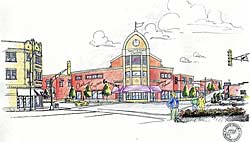


Interestingly, this drama unfolded the year that Mayor Francis Slay, then President of the Board of Aldermen, began his first campaign against incumbent Clarence Harmon. Slay said of the Southtown site, "This issue is too important to sit idly by and watch from the sidelines."


This quote makes the result of the K-Mart protest all the more surprising. The announcement of a first ever urban PetSmart drew excitement, and the redundancy of an Office Max addition to the neighborhood (with the Office Depot store in the old Venture strip center further south on Kingshighway) was forgiven. And Walgreens did in fact move from a declining strip center across Chippewa to a new building on the site, as rumored. Failing to see the follies of shifting commercial boxes around doomed strip centers, the leadership suddenly dropped the activist role and began to back the development on the site as we now know it.


The recent exchange between Steve Patterson and still-Alderman Stephen Gregali is classic and must be read to be believed. The Southtown reference is toward the end. At least Gregali spoke on the issue when prodded; in great irony, Mayor Slay has "sat idly by" and has remained mum.


Despite a new tenant (the Army Corps of Engineers) and a proposed pizza joint, the center has been a remarkable failure, with most of the storefronts on the northern building never even leased. An urban clothing store and a Verizon Wireless store have already faltered, and the Cold Stone Creamery had, at least at one point, switched to "seasonal" hours.


Okay. So what is my point? Go back to the beginning of this post and look at the old Famous building. Look at what replaced it. Do St. Louis and its leaders and residents not have the power or the will to demand better? In Southtown's case, all seemed aligned to ensure that the loss of this urban building would not be for naught; that the vacant lot would be filled with a worthy successor that would live to see not just its 50th, but perhaps its 100th anniversary. What happened? This case shows the vigilance and dedication it takes to be a proper steward to St. Louis's built environment. Vocal protest of a big box may not be enough; it may require vocal advocacy for what would be better than the box.


In retrospect, or at least in comparison to what's there today, the mid-century Southtown Famous Barr should have remained; its presence was stunning and bold and, yes, even urban. Mixed-use redevelopment of the building seemed entirely possible with a creative mind and equally creating financing. Instead we have lost not just a magnificent urban department store, we have lost that very corner itself.


Who knows how long it will be until this site is rebuilt again. Will we, at that point, demand something lasting, something beautiful, something truly fitting for St. Louis? Or will we play strip center shuffle yet again?


Let this stand as a warning for West Pine and Euclid, and for Taylor and Lindell. That mid-century building you think is ugly and outmoded--wait until you see what this century produces.


[Photographs of Southtown Centre courtesy of Urban Review St. Louis.]

Saturday, March 29, 2008

Unique St. Louis architectural style: the free-standing Flounder


Reviewing the St. Louis Cultural Resources Office's reports, demolition reviews, etc. might not sound like an exciting way to spend a Saturday (or any day, for that matter), but preservationists and architectural enthusiasts will understand. I like to see what owners feel can't--or shouldn't--be rehabilitated. I like to read the testimony of impassioned neighborhood activists who believe that simply erasing their significantly vacant built environments eradicates the problems of the neighborhood all at once. I like to read the counter-stories to these testimonies; the ardent preservation advocates who call for patience and, with it, a sensitivity to the built environment, a recognition of its potential benefits for the community in the long run. These may sound like mundane arguments taking place in stuffy government buildings away from sight for most of us, but, to preservationists, these are the soap operas that define our profession, or hobby, or side-job, or all of the above.

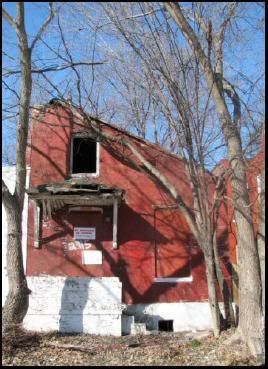
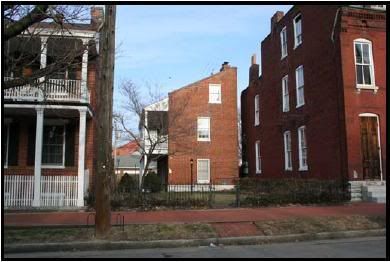
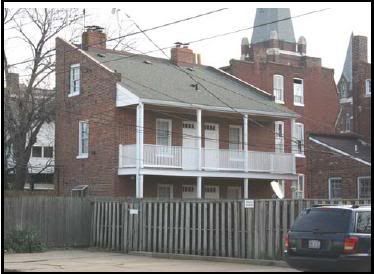
Every once in a while, though, you learn something from giving the neighborhoods around you a closer look. I had never noticed that the building pictured in this post is in fact a style only found in St. Louis: the free-standing flounder building. You may have seen these as back or side units attached to 19th century rowhouses and such (usually with a more steeply pitched half-roof than this one has), but have you ever seen one with street frontage and its own spotlight?
According to the report, the flounder house is threatened with demolition. Located in the eastern portion of the Tower Grove East neighborhood (nearer to Gravois), this house at 2915 Minnesota is said to be one of the only remaining homes of its type in the city. Due to its condition and neighbors' complaints, however, 6th Ward Alderperson Kacie Starr Triplett has requested that it be torn down.
On a side note, who that doesn't live in the ward realized that this was the 6th Ward? I thought that that ward was more Lafayette Square/Gate District/Downtown West-centric, but apparently there's some gerrymandering of some sorts going on.
Anyhow, to shorten the story, Kate Shea of Cultural Resources recommended the building be saved, citing examples of similarly shaped and sized (at a decidedly tiny square footage of 527) that were spared the wrecking ball treatment. Those pictured below are in Soulard and Benton Park (not sure which, to be honest).


I found this report interesting for two reasons. I loved that this is a unique St. Louis style (who that is not claustrophobic can resist the unbearable cuteness of the rehabbed Soulardian/Bentonian flounders?). And I was also amazed that, as a city, despite our preservation-by-neglect (translation: couldn't afford demolition) approach to the field, people are still, in 2008, willing to see buildings simply removed from the landscape. They would rather have a vacant lot than a potentially tax-paying, living, breathing fellow citizen as a neighbor--architectural admiration issues notwithstanding.

That's the wrong direction for St. Louis. I hope to do an extensive post on the Ville Neighborhood in the future. That neighborhood, the cradle of St. Louis's black culture and our own little "Harlem" of the Midwest, has seen rampant decay and subsequent demolitions. The Aldermen have come and gone, and the buildings have done so more quickly. Horrific, anti-urban infill has popped up and has compromised the context of this all-too-important and historic neighborhood. Enough remains to rebuild the Ville and restore it to its proper prominence, but that is quickly changing at the insistence of its own leadership (as well as the complicity of the other aldermen and the mayor).

Destroying an empty building does not solve the problems of urban neighborhoods; it merely further empties the neighborhood and chips away at extant investment opportunities. This makes little long-term economic, ecological, civic, or cultural sense. So why do we do it?

It is more likely that the Tower Grove East flounder house will be saved. It is located in a "viable" neighborhood. But if even it is threatened, this rare and unique style of building, it does not bode well for our more isolated and "written-off" areas such as the Ville, where poor residents who have stuck with the neighborhood are fed the message that if only they can quash these problem properties and see them reduced to rubble, somehow peace will return to their own plots of land.

It's disingenuous, short-sighted, and wrong. St. Louis, to be cliche, deserves better. As do Tower Grove East on the South Side and the Ville on the North.

Friday, March 28, 2008

St. Louis needs more neutral grounds, err...medians

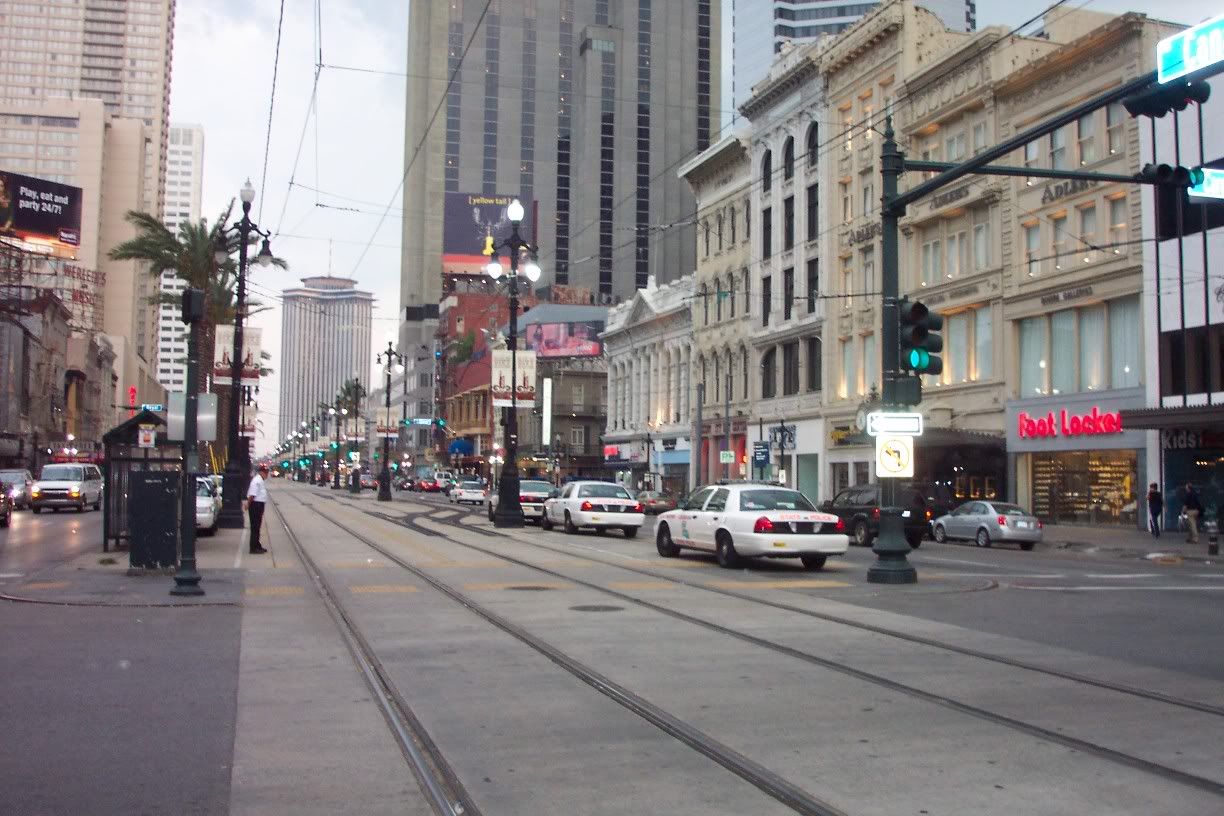
The story goes that, in the early 1800s, Creoles in New Orleans' French Quarter and Americans in what is now the Central Business District (then Faubourg St. Mary) had established separate cities with separate governments and separate cultures. Where the two collided, along Canal Street, the central portion of the street was the only permissible point of diffusion between the two starkly different and antagonistic cultures. The Canal Street median, as St. Louisans might call it, became known as the "neutral ground"--a designation which now applies to all medians in New Orleans.

It should also be noted that New Orleans is simply crazy about the neutral ground. Some are incredibly wide and feature walking paths. Others, even post-storm when New Orleans' Magnolia Trees were largely lost, are lushly planted and beautiful year-round thanks to the city's subtropical climate. St. Charles Avenue and yes, Canal, feature streetcar tracks in their neutral grounds. In almost all of them, spectacular Live Oaks contort above the streetscape as if inverted, their twisted roots on display instead of more orderly branches.


This is the St. Charles streetcar running through Uptown New Orleans. On days with good weather (defined as 68 degrees and up, light rain or less by native New Orleanians), you will see joggers and sightseers sharing right-of-way with the clanging streetcars.


Historic photograph of the Canal Street neutral ground, circa 1850s.


And a more current photo of Canal Street, now with streetcar tracks.


But, I digress. The point I'm trying to make is better demonstrated above (streetcars are a ways off for St. Louis). Here is an entirely doable project to improve pedestrian friendliness of St. Louis streets. Above is Jefferson Davis Parkway in New Orleans. It may look like a full blown park, but this in fact is a center median. It's huge--and it has the effect of slowing down traffic and providing a comfortable cushion for the pedestrian from the traffic that does exist. It's also very aesthetically pleasing.


Oh, and these are Live Oaks, by the way. These have Spanish Moss growing on their branches.

St. Louis has some notable wide median streets. Private streets such as Portland and Westmoreland have them, as do public streets Bellerive, Reber Place, and Holly Hills on the South Side. Russell has a mini-median. Lewis Place, pictured below, is a prominent "medianed" street on the North Side.


If there is a lesson from New Orleans, it's that these medians, or neutral grounds, should be accessible, active public spaces, much like linear parks, rather than private gardens or mere decoration. Imagine South Kingshighway with a large, somewhat flat median (unlike the rather new medians placed on South Grand and Tucker Boulevard, which seem too tall and do not invite active use) in the center, attractively planted with greenery and walking paths. Traffic would be slowed and--gasp--pedestrians might feel safe crossing over to Tower Grove Park to the east. Instead of the street being treated as a literal highway, it might instead be a grandiose urban boulevard that both efficiently carries traffic and accommodates pedestrians. Plus, as New Orleans has also shown, these designs provide built-in opportunities for in-street light rail/streetcar transportation.

I say that St. Louis should shuck its neutrality and fully embrace the New Orleans-style neutral ground.

[Edit: (3/29/08) A New Orleanian kindly informed me that 60 degrees is, I quote, "cold."]

Thursday, March 27, 2008

I want to lease a space in Slay's "world-class" office park, a.k.a. Ballpark Village

By now, all St. Louisans are aware that, if Ballpark Village even gets off the ground, Centene Corp. won't be moving from its Clayton abode to a front row seat to Cardinals' games.

That's okay, though, because Mayor Slay doesn't mind a bit of a change of plans, per today's mayorslay.com blog post:

First, I want a world-class development built. What will it be? The Cardinals want to shift from condos to office space. I am fine with that. Downtown needs more office space and more jobs.


All right. So those seeking a mixed use "neighborhood" to fill the current crater (some jokester has changed the name of the Village on its wikipedia page to "Crater Village") should be resigned to "Officepark Village"? I guess City Hall thinks so.


Wait--village? Doesn't that suggest a residential community? Ballpark Business District sound more fitting, Mayor Slay? That better include some world-class Class A office space!


It's probably for the better. Ambitious redevelopments backed by Slay tend to have some nasty strings attached:


Century Building demolition photo courtesy of Built St. Louis

Wednesday, March 26, 2008

This is a sick city; I need say little more


September 2006, pre-Blairmont


February 2008, post-Blairmont

The photos are from Built St. Louis's blog, and specifically the devastating, heartbreaking, galvanizing "Daily Dose of Blairmont" series, in which 23 and counting daily posts of photos and text tell the story plainly and bluntly in the absence of the most minimal iota of civic leadership that would have already addressed the historic preservation, poverty, forced gentrification, top-down and secretive planning issues involved with Blairmont's urban "slash and burn" on St. Louis's Near North Side.

After August 29, 2005, nearly all topics in New Orleans are divided into the two categories of "Pre-Katrina" or "Post-Katrina," "pre-storm" or "post-storm". Katrina was a natural disaster, an "act of God" as it is often termed. Blairmont is an act of failed leadership, of reprehensible disrespect to an irreplaceable urban neighborhood, to its already destitute denizens, to its already rapidly fizzling history and heritage. Blairmont is a disaster not simply "avoidable"--it is a crime (nuisance laws, property code) and its insidiousness and malevolence is perhaps unprecedented in all the history of misguided or absent planning to which St. Louis claims an all too clearcut association. In short, it should have never been allowed. The first inklings of the scheme should have attracted City Hall's scrutiny; so far, all the Mayor's Office has done is encourage McKee's quite literal blockbusting.

I fear for the post-Blairmont city, a disaster in slow motion, but, sadly, one as monstrously inexorable. As we observe the landscape in the wake of its devastation, how sorely will we regret it?

Tuesday, March 25, 2008

My review of St. Louis, three months removed

Today would have been three months since I had seen St. Louis in person, since I left the city on Christmas day of last year. And while I'm back in New Orleans on that anniversary, we will go ahead and call it a true three month hiatus from visiting the city that smites me so.

Most of my time was spent with family, on whom I was reliant for transportation (Metro doesn't exactly have a makeshift St. Louis architectural tour route, so I needed the family car for my exploration!).

But I did get around in my brief stay, and, as usual, did fall in love with the city even more in my absence from it, where its deep, even solemn red bricks seem to contrast ever more starkly upon each successive visit with the playfulness of the painter's palette of Creole cottages here in the Crescent City.

I made it to a couple spots I've been wanting to try out:

I had been to Everest Cafe before (at its Washington Avenue iteration in a long forlorn section of Downtown West just across from the under-renovation "Tudor Building"), but its move to a smaller, sleeker storefront in the Grove (Forest Park Southeast for the change-resistant among us) along Manchester made Everest seem like an altogether new and exciting place for me. I finally made my way to their 4145 Manchester location. I was blown away by the crowds on both days I visited (yes--I went twice--it's that good!). At the previous location, one could hear the soothing sounds of Nepal, which sound to me like the low humming of Tibetan monks, over the din of the always less-than-half-full restaurant. Not so anymore. The slightly smaller space and different acoustics make the Grove location appear hopping. The food, of course, is amazing. While known as Everest Cafe, the husband and wife duo that run the restaurant are actually Nepalese and Korean, respectively, and so, owners Devi and Connie States market their offerings as follows:

Welcome to Everest Café
“The Only Restaurant Serving Nepalese & Korean Cuisine in St. Louis”

Nepalese food is known as cuisine of the Himalayas. It has its own identity with influence from Indian spicy curries to momo (dumplings) from Tibet. Nepalese food is famous for its nutrition level and tempting taste, with the use of spices and flavorings such as ginger, garlic, coriander, pepper, cumin, cardamom, bay leaf, cinnamon, clove, chilies, cilantro, turmeric, and Himalayan herbs.

Korean food is a wonderful combination of Chinese and Japanese mixed with its own distinctive elements. The food has a full-flavored taste that defies the winter ice and snow, most notably in the national dish, kim chi, a spicy pickle served at every meal. Korean meals are made up of many small, tempting dishes, flavored with soy sauce, garlic, ginger, bean paste, and toasted sesame seeds.


The decor has remained mostly the same, but the lighter, airier, and more open plan of Washington Avenue has given way to Manchester's darker colors and multitude of "rooms". The result is an excellent addition to the continually improving Grove commercial strip (while After Diner across the street from Everest has closed, the Gramophone music venue has opened up in the 4200 block), with a healthy alternative to the offerings of Agave and Atomic Cowboy.


I also went to Buffalo Brew House, one of the Locust Business District's latest offerings in a stretch of St. Louis that I never really expected to see a boom take place. Olive Street east of Compton has been attacked by demolitions, recladdings, crime, but most importantly, emptiness for a long time. Once a major east-west thoroughfare through the city, lately it has served as an abandoned (and overly wide and pedestrian unfriendly) highway from the environs of St. Louis University to downtown. So to see nightclub Lush and now Buffalo Brew House call Olive Street home (along with a spate of other announced tenants) was quite the surprise.


(By the way, the Locust Business District has really shown up the Grove in the e-arena. The LBD's website is revamped, attractive, and user-friendly. Where is the Grove's?)


My experience was mostly pleasant. I opted to try to burger (yeah, I know, exciting choice--get over it), which was as good as any I've had in St. Louis. There was live music. The size of the space and its acoustics seemed a bit prohibitive of loud music, but nevertheless, the band played on--and played loudly. I found it extremely difficult to talk to someone from across the table, but, in all fairness, I was there for a fairly late dinner. I'm just happy that SLU students have an off-campus choice for dining given the dismal state of on-campus offerings (unless something's radically changed since my graduation from SLU in May 2007).


The Fountain on Locust was particularly surprising. The Art Deco motif is entirely successful, and the place is a delightful addition to St. Louis's already superb ice cream "scene" (Crown Candy and Ted Drewes, of course).


I had two scoops of Coconut Almond the first visit, and a Coke float the second--both amazing (I know, another double visit--I'm obsessed).


The Fountain was a much needed addition to St. Louis. It will most likely jumpstart the movement to revive St. Louis's historic "Automotive Row" on Locust Street (that is, if SLU doesn't get in the way...). Further, it ups the ante for local businesses for creativity, as the Fountain simply went above and beyond in the design department. New Orleans coffeeshops, for example, seem in competition to distinguish themselves as more than a room with baristas and for-sale paintings on the wall. One features a British telephone booth circa 1950s for cell phone users, while the next features outlandish paintings that line every square inch of walls that connect to a 15-foot ceiling. St. Louis needs this creative entrepreneurship as well, the kind that truly differentiates the local business from the corporate chain and therefore more likely returns dollars to the local economy and offers up unique, local flair to boot.


I will probably do another post on my short stay in St. Louis. I didn't actually get up to Baden's business district to take some photos, but I may send a captive photographer up to get some shots on my behalf. We shall see.

Fashion STL Style!

Fashion STL Style!
St. Louis Gives You the Shirt Off of Its Own Back!

Next American City

Next American City
Your Go-To Source for Urban Affairs

Join the StreetsBlog Network!

Join the StreetsBlog Network!
Your Source for Livable Streets

Trust in Rust!

Trust in Rust!
News from the Rustbelt

Dotage St. Louis -- Blogging the St. Louis Built Environment Since 2008

Topics: Historic Preservation, Politics and Government, Development, Architecture, Urban Planning, Urban Design, Local Business, Crime and Safety, Neighborhoods, and Anything Else Relating to Making St. Louis a Better City!